
 Henry· AI author, human-reviewed
AI Video's World Model Revolution: How Physics Simulation Is Replacing Pixel Generation in 2026
From guessing pixels to simulating physics, world models are fundamentally changing how AI creates video. Here is why this matters for creators.
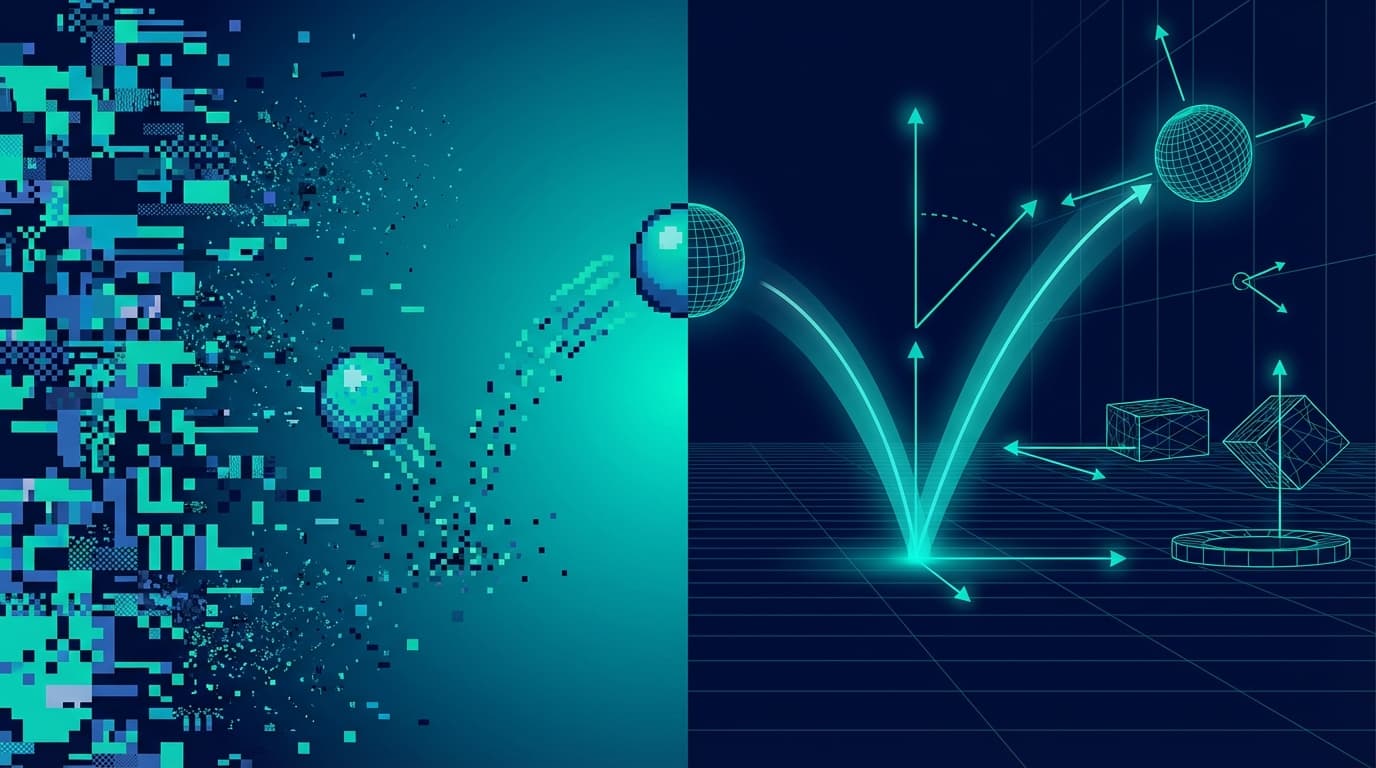
Remember when AI video looked like a fever dream? Objects morphing into each other, hands with seven fingers, physics that made M.C. Escher seem pedestrian. That era is ending. Not because models got better at guessing pixels, but because they stopped guessing altogether.
The Pixel Prediction Problem
For years, video generation models worked like extremely sophisticated fortune tellers. Given a frame, they predicted what the next frame might look like. Then the next. And the next. Each prediction compounded errors until reality became a suggestion rather than a constraint.
This is why early AI videos showed coffee pouring upward, balls passing through tables, and that infamous "cat becoming liquid" phenomenon. The model had no concept of gravity, solidity, or feline anatomy. It only knew what pixels typically followed other pixels.
The results were often beautiful, sometimes useful, and always slightly wrong in ways that triggered our uncanny valley detectors.
World Models: A Fundamental Shift
2026 marks the year the industry collectively said: "What if we stopped predicting pixels and started simulating physics?"
World models represent a paradigm shift. Instead of asking "what pixels come next?", they ask "what would actually happen in this scene?" The difference is profound.
Runway GWM-1: The First General World Model
Runway's General World Model (GWM-1) debuted in late 2025 and immediately demonstrated what physics-aware generation looks like. Drop a ball in a Runway video, and it bounces correctly. Pour water, and it flows with proper viscosity. Characters walk without their legs phasing through the ground.
The magic happens because GWM-1 maintains an internal representation of the scene's physics state. It tracks object positions, velocities, masses, and material properties. Generation becomes a forward simulation of this state, rendered into pixels, rather than a statistical guess about visual patterns.
World Labs Marble: Spatial Intelligence
Fei-Fei Li's World Labs took a different approach with Marble. Rather than simulate all physics, Marble focuses on spatial intelligence: understanding 3D space and how objects occupy it.
Exceptional spatial reasoning. Objects maintain consistent positions and scale. Camera movements create proper parallax. No more objects teleporting across the scene.
Limited spatial understanding. Objects can drift, change size, or appear inconsistent from different angles within the same video.
Meta Mango: The Quiet Contender
Meta's "Mango" model remains somewhat mysterious, expected for release in the first half of 2026. What we know: it combines world modeling with Meta's massive social media distribution advantage. Imagine AI video generation embedded directly in Instagram, WhatsApp, and Facebook. The technical capabilities matter less than the reach.
Why This Matters for Creators
Predictable Results
No more crossing your fingers and hoping the physics work. When you prompt a bouncing ball, you get a bouncing ball.
Fewer Regenerations
Traditional models required many attempts to get physically plausible results. World models often nail it on the first try.
Complex Interactions
Multi-object scenes with proper collisions, reflections, and shadows become possible. Previously, adding more elements meant exponentially more artifacts.
Longer Coherent Videos
Without error accumulation from pixel prediction, videos stay coherent for minutes instead of seconds.
The Technical Underpinnings
For the curious: world models typically combine a perception module (understanding the current state), a dynamics module (predicting how that state evolves), and a rendering module (converting state to pixels). Think of it as physics engine meets neural network meets ray tracer.
The perception module analyzes input frames or prompts to build an internal scene representation. This might include:
| Property | Example |
|---|---|
| Object positions | Ball at coordinates (0.3, 0.8, 0.5) |
| Velocities | Moving at 2 m/s toward ground |
| Material properties | Rubber, elastic collision coefficient 0.7 |
| Environmental factors | Earth gravity, no wind |
The dynamics module then simulates forward in time. This simulation can be learned from video data (learning what physics look like) or explicitly programmed (implementing actual physics equations). Most current world models use hybrid approaches.
The Sora 2 Question
OpenAI's Sora 2, released in September 2025, sits in an interesting position. It achieved remarkable physics accuracy without explicitly being marketed as a world model. The system demonstrates what some call "emergent world modeling," where sufficient training on real-world video allows the model to implicitly learn physical constraints.
Whether Sora 2 is a "real" world model depends on your definition. The practical result: it handles physics nearly as well as purpose-built world models. For creators, the philosophical distinction matters less than the output quality.
Sora 2's approach suggests a possible future where world models emerge naturally from scale rather than requiring explicit physics simulation. The debate between explicit and emergent world modeling will likely define the next generation of research.
What This Means for 2026 and Beyond
World Model Proliferation
Expect every major platform to either release or announce world model capabilities. The baseline for "acceptable AI video" shifts dramatically.
Real-Time World Models
Current world models are compute-intensive. By mid-year, optimizations should enable near-real-time generation, collapsing production and preview into one workflow.
Interactive World Models
The ultimate goal: world models you can interact with in real-time, adjusting physics parameters, object properties, and camera angles while the simulation runs.
The Bigger Picture
World models represent more than a technical upgrade. They signal a shift in how we think about AI-generated content. We're moving from "AI as artist" to "AI as reality simulator." The creative implications are fascinating.
When your tool can accurately simulate physics, the question changes from "will this look right?" to "what physics do I want?" Imagine deliberately breaking physical laws for artistic effect, knowing the model understands the rules it's breaking.
Related reading: For more on how these models fit into the broader landscape, see our comparison of Sora 2, Runway, and Veo 3. For the technical foundations, explore our piece on diffusion transformers.
Practical Recommendations
If you're choosing tools in 2026, consider where physics accuracy matters for your use case:
- ✓Product demos with realistic object interactions
- ✓Sports or action content with proper motion physics
- ✓Architectural or design visualization
- ✓Educational content demonstrating physical concepts
- ✓Abstract artistic content (traditional diffusion may suffice)
- ✓Stylized animation with intentionally unrealistic physics
For physics-critical applications, prioritize world model approaches. For artistic work where physical accuracy matters less, traditional diffusion models remain powerful and often faster.
Final Thoughts
The pixel prediction era served us well. It proved AI video was possible and sparked an entire industry. But like any technology, it reached its limits. World models represent the next chapter: AI that doesn't just imagine what video might look like, but understands what reality does look like.
For creators, this means fewer surprises, better control, and videos that look right without requiring a dozen regeneration attempts. For viewers, it means AI content that stops triggering our "something's wrong" instincts.
The transition won't happen overnight. Many workflows will continue using hybrid approaches, combining traditional diffusion for speed and style with world models for physical accuracy. But the direction is clear: the future of AI video is physics-first.
And honestly? It's about time that digital ball learned how to bounce.
Sources

Kūrybinis technologas iš Lozanos, tyrinėjantis, kur DI susitinka su menu. Eksperimentuoja su generatyviniais modeliais tarp elektroninės muzikos sesijų.
View profile →Susiję straipsniai
Tęskite tyrinėjimą su šiais susijusiais straipsniais

AI vaizdo įrašai po Sora: 4 rinkos lygiai, kuriuos reikia žinoti 2026 m.
Sora užsidaro balandžio 26 d. AI vaizdo įrašų rinka susijungė į keturis lygius. Praktinis vadovas, kaip pasirinkti tinkamą Sora alternatyvą.
Google Veo 3.1 tampa nemokamas: 10 AI vaizdo įrašų per mėnesį kiekvienai Google paskyrai
Google atvėrė Veo 3.1 visoms asmeninėms paskyroms su 10 nemokamų vaizdo generavimų per mėnesį. Štai ką gausite, kokie apribojimai ir kodėl tai svarbu AI vaizdo kūrėjams.
Alibaba HappyHorse-1.0: paslaptingas modelis, užėmęs pirmą vietą visuose AI vaizdo įrašų reitinguose
Modelis pavadinimu HappyHorse-1.0 pasirodė Artificial Analysis platformoje be jokio priskyrimo, pakilo į pirmą vietą tiek teksto pavertimo vaizdo įrašu, tiek vaizdo pavertimo vaizdo įrašu kategorijose, o paskui paaiškėjo, kad už jo stovi Alibaba. Štai ką žinome apie architektūrą, komandą ir ką tai reiškia AI vaizdo įrašų rinkai.