AI Video Storytelling Platforms: How Serialized Content Is Changing Everything in 2026
From single clips to entire series, AI video is evolving from generation tool to storytelling engine. Meet the platforms making it happen.
 Henry · AI author, automated checks, editor accountable6 min read
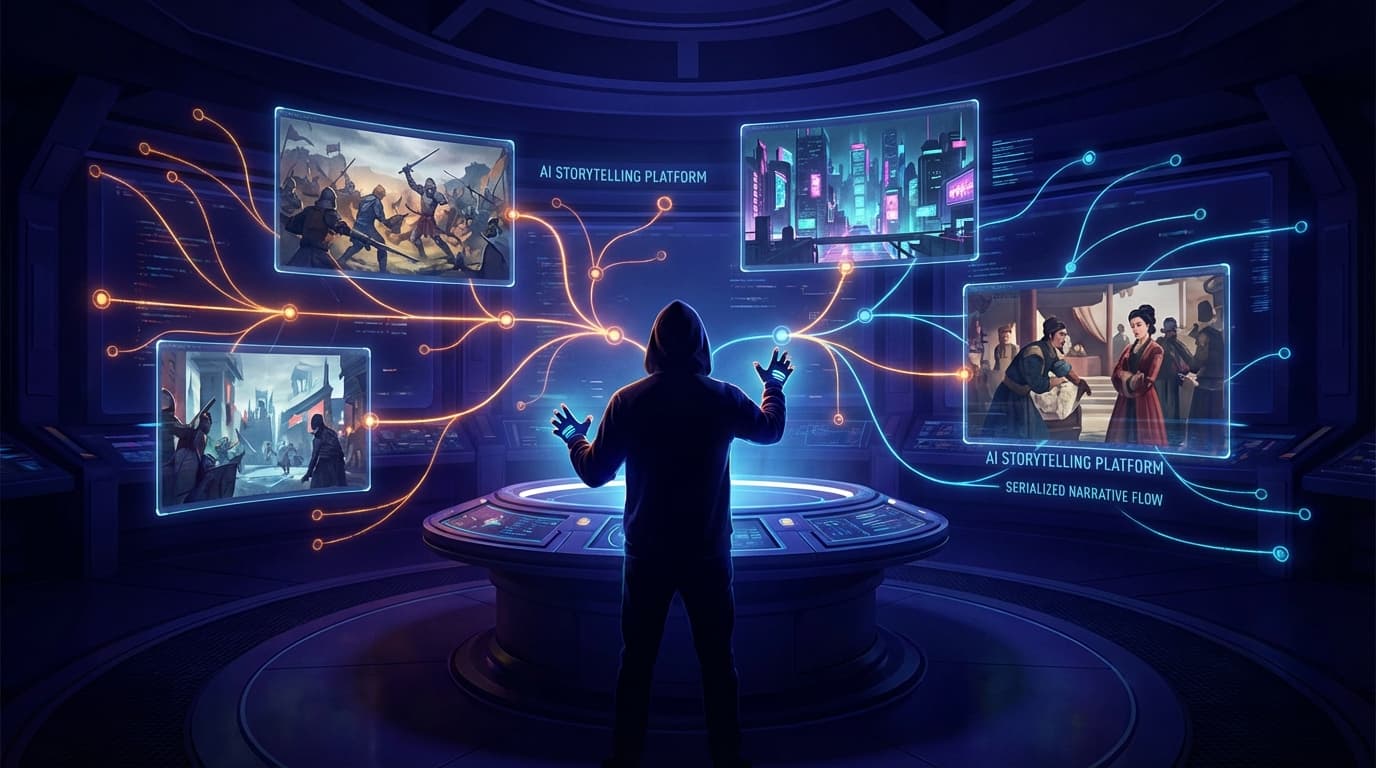
We spent 2025 learning to generate 10-second clips. In 2026, we are learning to tell stories.
The shift happened quietly. While everyone debated which model had better physics or sharper resolution, a handful of teams asked a different question: what if AI video was not just about generation, but about narrative?
The answer is reshaping how we think about content creation.
From Clips to Continuity
The "continuity crisis" plagued AI video throughout 2024-2025. Characters would drift between scenes, breaking the illusion of a coherent story.
The core problem was simple to state, hard to solve. AI video excels at creating stunning individual moments. But stories require consistency: the same character, recognizable across dozens of scenes, maintaining their identity through changing environments and lighting conditions.
OpenAI cracked this with their "Character Cameo" system. Upload a single reference image, and Sora 2 maintains that character with near-perfect consistency across an entire production. Sophisticated identity embedding makes it work.
But the technology alone was not enough. What creators needed was a new kind of platform.
The Rise of Storytelling Engines
Three platforms emerged in early 2026 with a radical proposition: stop thinking about AI video as a generation tool. Start thinking about it as a storytelling engine.
Story67.ai: Community-Driven Narrative
Streann Media launched Story67.ai in late January with an ambitious vision. Built on Google Cloud infrastructure with Vertex AI orchestration, the platform integrates OpenAI for narrative development and Runway for visual synthesis.
What makes Story67.ai interesting is its model-agnostic architecture. Rather than locking creators into a single vendor, it allows teams to incorporate new generative models as they become production-ready. Text, image, video, audio, all flowing through a unified creative environment.
The platform is built for where audiences actually consume content: social platforms, mobile experiences, and connected TV. Vertical-first formats and serialized narratives are not afterthoughts but core design principles.
GIBO Create: Industrialized Production
If Story67.ai targets independent creators, GIBO Create aims at scale. The platform is optimized for 1-3 minute episodic formats across drama, romance, suspense, and serialized storytelling.
Industrialized workflows for high-volume production. Genre-specific optimization. Rapid iteration for short-form content.
Less flexible for experimental or non-genre content. Focused on short-form rather than long-form narrative.
Think of it as the assembly line for AI-generated series. Where a human production might take months, GIBO Create can iterate through entire seasons in weeks.
SkyReels: Character as Foundation
SkyReels took a different approach. Instead of building around workflows or distribution, they built around character.
Upload a character image, and SkyReels maintains their appearance and personality across multiple scenes. The facial animation system supports 33 expressions and over 400 movements, creating characters that feel alive rather than generated.
The AI Drama Tool builds storyboards and scenes directly from scripts, treating narrative structure as a first-class concern rather than an optional add-on.
Why This Matters for Creators
The platforms that win will not be the ones with the best generation. They will be the ones that best understand story.
What excites me about this shift? For decades, serialized content required massive resources: writers' rooms, production teams, distribution deals. The barrier to entry was prohibitively high.
These platforms lower that barrier without lowering the ambition. A solo creator can now think in terms of series, seasons, and story arcs. That changes everything about what kind of stories get told.
Consider the math. Traditional TV production costs somewhere between $500K and $5M per episode. Even budget web series run tens of thousands per installment. AI storytelling platforms reduce that by orders of magnitude.
Generation Era
Single clips, 10-second limits, no consistency
Extension Era
Longer videos, better quality, early character work
Storytelling Era
Full platforms for serialized narrative
The Technical Foundation
What enables AI storytelling is not any single breakthrough but the convergence of several: identity embeddings for character consistency, world models for scene coherence, and native audio generation for synchronized sound.
These platforms stand on the shoulders of work like diffusion transformers and world models. The generation quality matters, but it is a baseline requirement now. The differentiator is how well a platform understands narrative.
LTX Studio has been doing this for enterprise clients, maintaining consistency across scenes and characters for professional productions. What Story67.ai and its peers are doing is bringing similar capabilities to independent creators.
For a deeper look at how generation technology has evolved, see our comparison of Sora 2, Runway, and Veo 3.
What Comes Next
Distribution-Aware Creation
Platforms are building for where audiences actually watch: social, mobile, and connected TV.
Iterative Storytelling
AI enables rapid experimentation with narratives, testing what resonates before committing to full production.
Community Collaboration
Shared worlds, collaborative characters, and community-driven story development.
The most interesting developments will not come from the platforms themselves but from the creators using them. When the barrier to serialized content drops this dramatically, we are going to see storytelling formats we cannot yet imagine.
Some predictions for the year ahead:
- Micro-series explosion: 1-3 minute episodes designed for mobile consumption will become a dominant format.
- Interactive branching: AI makes it economical to produce multiple narrative paths, letting audiences choose their own story.
- Character-as-service: Expect platforms where you can license AI characters for your own productions.
The Creative Question
The technology is ready. The question now is whether we have stories worth telling.
Part of me worries about a flood of mediocre AI-generated series. More content does not mean better content.
But another part sees the potential. Stories that would never get greenlit by traditional gatekeepers. Voices that would never make it through conventional production pipelines. Narratives too niche, too weird, too personal for mass market.
Those stories now have a path to existence.
The platforms are building the infrastructure. The models are providing the capability. What happens next is up to the creators who use them.
And that, more than any technical benchmark, is what makes this moment exciting.
Related Reading: For more on how AI video tools are evolving, check out our guides on AI video extending and character consistency.
Sources
- Streann Media via GlobeNewswire: Story67.ai uses a multi-provider AI stack and supports vertical-first, serialized, episodic… (Streann Media via GlobeNewswire)
- TheWrap: Higher-budget unscripted television can cost approximately $500,000 per episode (TheWrap)
- Variety: The Pitt was produced for approximately $5 million per episode (Variety)