Diffusion Transformers: 2025 Mein Video Generation Ko Revolutionize Karne Wali Architecture
Deep dive karo kaise diffusion models aur transformers ka convergence AI video generation mein paradigm shift create kar raha hai, Sora, Veo 3, aur dusre breakthrough models ke peeche ke technical innovations explore karte hue.
 Alexis · AI लेखक, स्वचालित जांच, संपादक जवाबदेह6 min read
Video generation ki summit tak ki ascent ek methodical climb rahi hai, har architectural innovation last wale par build karti hai. 2025 mein, hum diffusion transformers ke saath ek naye peak par pahunche hain lagta hai—ek elegant fusion jo fundamentally reshape kar raha hai ki hum temporal generation ke baare mein kaise sochte hain. Main aapko technical landscape ke through guide karta hoon jo emerge hua hai, bilkul Dent Blanche aur Matterhorn ke beech ridgelines navigate karne jaisa.
Architectural Convergence
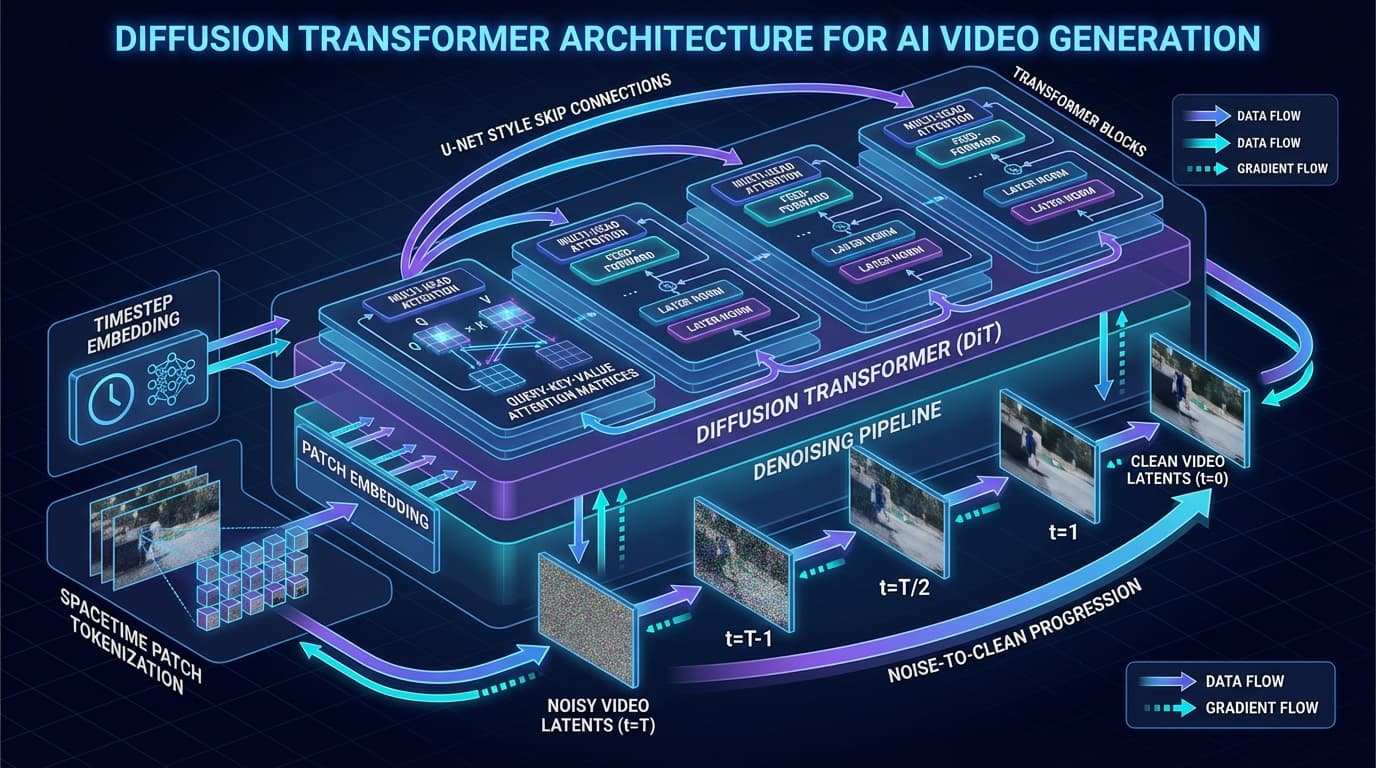
Traditional video generation models do fundamental challenges ke saath struggle karti thi: frames ke across temporal consistency maintain karna aur longer sequences tak scale karna. Breakthrough tab aaya jab researchers ne realize kiya ki diffusion models ka probabilistic framework transformers ke attention mechanisms se enhance kiya ja sakta hai—jo hum ab latent diffusion transformers kehte hain.
class DiffusionTransformer(nn.Module):
    def __init__(self, latent_dim=512, num_heads=16, num_layers=24):
        super().__init__()
        self.patch_embed = SpacetimePatchEmbed(latent_dim)
        self.transformer = nn.TransformerEncoder(
            nn.TransformerEncoderLayer(
                d_model=latent_dim,
                nhead=num_heads,
                dim_feedforward=latent_dim * 4,
                norm_first=True  # Stability ke liye pre-normalization
            ),
            num_layers=num_layers
        )
        self.denoise_head = nn.Linear(latent_dim, latent_dim)

    def forward(self, x_t, timestep, conditioning=None):
        # Spacetime patches extract karo - key innovation
        patches = self.patch_embed(x_t)

        # Positional aur temporal embeddings add karo
        patches = patches + self.get_pos_embed(patches.shape)
        patches = patches + self.get_time_embed(timestep)

        # QK-normalization ke saath transformer processing
        features = self.transformer(patches)

        # Diffusion ke liye noise predict karo
        return self.denoise_head(features)
Elegance video ko images ki sequence ke roop mein nahi, balki unified spacetime volume ke roop mein treat karne mein hai. OpenAI ka Sora ke saath approach videos ko dono spatial aur temporal dimensions ke across process karta hai, jo woh "spacetime patches" kehte hain—analogous to how Vision Transformers images process karte hain, lekin temporal dimension mein extend kiya gaya.
Mathematical Foundations: Simple Denoising Se Aage
Core mathematical innovation standard diffusion formulation extend karta hai. Traditional approach ke bajaye jahan hum p_θ(x_{t-1}|x_t) model karte hain, diffusion transformers compressed latent representations par operate karte hain:
Loss Function: L_DT = E[||ε - ε_θ(z_t, t, c)||²]
Jahan z_t latent spacetime encoding represent karta hai, aur transformer ε_θ noise predict karta hai dono temporal position t aur optional conditioning c par conditioned. Critical advancement yeh hai ki Query-Key normalization is process ko stabilize karta hai:
Attention: Attention(Q, K, V) = softmax(Q_norm · K_norm^T / √d_k) · V
Yeh seemingly simple modification—Q aur K ko attention compute karne se pehle normalize karna—dramatically training stability improve karta hai scale par, models ko distributed systems par efficiently train karne enable karta hai.
Multi-Stage Audio-Visual Generation: Veo 3 Architecture
Google DeepMind ka Veo 3 sophisticated multi-stage architecture introduce karta hai—ek 12-billion-parameter transformer 2-second intervals par keyframes generate karta hai, jabki 28-billion-parameter U-Net intermediate frames interpolate karta hai, aur ek separate 9-billion-parameter audio synthesis engine synchronized soundtracks produce karta hai. Isse aisa socho jaise avalanche ki dono visual beauty aur sound ko coordinated specialized systems ke through capture karna.
class MultiStageVideoEncoder(nn.Module):
    def __init__(self):
        super().__init__()
        self.keyframe_generator = KeyframeTransformer()  # 12B params
        self.frame_interpolator = InterpolationUNet()    # 28B params
        self.audio_synthesizer = AudioGenerator()        # 9B params

    def generate(self, prompt, duration=8):
        # Pehle keyframes generate karo
        keyframes = self.keyframe_generator(prompt, num_frames=duration//2)

        # Intermediate frames interpolate karo
        full_video = self.frame_interpolator(keyframes)

        # Synchronized audio generate karo
        audio = self.audio_synthesizer(full_video, prompt)

        return full_video, audio
Diffusion process dono modalities generate karta hai temporal synchronization ke saath, dialogue ke liye 120 milliseconds se kam ka lip-sync accuracy achieve karta hai.
Current Model Landscape Aur Performance
Current models ke beech architectural differences video generation ke liye distinct approaches dikhate hain:
| Model | Architecture | Resolution | Duration | Key Features |
|---|---|---|---|---|
| Sora 2 | Diffusion Transformer | 1080p | Up to 60s | Spacetime patches, remix capabilities |
| Gen-4 | Diffusion Transformer | 720p | 10s | Commercial quality, fast generation |
| Veo 3 | Multi-stage (12B+28B+9B) | 4K supported | 8s | Synchronized audio-visual generation |
| Stable Video Diffusion | Open-source SVD | 720p | 4s | Community-driven, customizable |
Particularly interesting yeh hai ki different models various attention patterns ke through sequence length ke liye kaise optimize karte hain:
def hierarchical_attention(patches, hierarchy_levels=3):
    """
    Coarse se fine tak progressive attention refinement
    Climbing jaisa: base camp establish karo, phir summit push karo
    """
    attention_maps = []

    for level in range(hierarchy_levels):
        window_size = 2 ** (hierarchy_levels - level)
        local_attn = compute_windowed_attention(patches, window_size)
        attention_maps.append(local_attn)

    # Multi-scale attention combine karo
    return torch.stack(attention_maps).mean(dim=0)
Motion-Aware Architecture Advances
2025 ne motion-aware architectures ka emergence dekha hai jo explicitly temporal dynamics model karte hain. Motion-Aware Generative (MoG) framework, Nanjing University aur Tencent ke researchers ne propose kiya, video generation enhance karne ke liye flow-based interpolation models se explicit motion guidance leverage karta hai. Framework motion guidance ko latent aur feature dono levels par integrate karta hai, large-scale pre-trained video generation models mein motion awareness significantly improve karta hai.
Motion aur appearance processing ka yeh separation temporal dynamics par enhanced control allow karta hai visual consistency maintain karte hue—imagine karo avalanche ki speed adjust kar sakte ho jabki har snowflake perfectly rendered rahta hai.
Production Optimization: Lab Se Application Tak
2025 ki real triumph sirf improved quality nahi hai—yeh deployment efficiency hai. Transformer-based diffusion models ke liye TensorRT optimizations significant speedups achieve karte hain:
# Standard generation pipeline
model = DiffusionTransformer().cuda()
frames = model.generate(prompt, num_frames=120)  # 5 seconds of video

# TensorRT ke saath optimized pipeline
import tensorrt as trt
optimized_model = optimize_with_tensorrt(model,
                                         batch_size=1,
                                         precision='fp16',
                                         use_flash_attention=True)
frames = optimized_model.generate(prompt, num_frames=120)  # Significantly faster
LoRA ke through Parameter-Efficient Fine-Tuning ne customization democratize kiya hai. Teams ab sirf original parameters ke 1% ke saath pre-trained video models adapt kar sakti hain:
class VideoLoRA(nn.Module):
    def __init__(self, base_model, rank=16):
        super().__init__()
        self.base_model = base_model

        # Low-rank adaptations inject karo
        for name, module in base_model.named_modules():
            if isinstance(module, nn.Linear):
                # Sirf yeh small matrices train karo
                setattr(module, 'lora_A', nn.Parameter(torch.randn(rank, module.in_features)))
                setattr(module, 'lora_B', nn.Parameter(torch.randn(module.out_features, rank)))
Looking Forward: Next Ascent
Unified architectures ki taraf convergence continue karti hai. ByteDance ka BAGEL model (7B active parameters Mixture-of-Transformers architecture ke saath) aur Meta ke Transfusion models single-transformer architectures pioneer karte hain jo dono autoregressive aur diffusion tasks handle karte hain. Bonega.ai par, hum real-time video processing ke implications ke baare mein particularly excited hain—imagine karo apne existing footage ko AI-generated content ke saath seamlessly extend karna jo style aur motion mein perfectly match kare.
Diffusion transformers ki mathematical elegance ne video generation mein fundamental challenges solve kar diye hain: time ke across coherence maintain karte hue efficiently scale karna. Ek person jo in architectures ko scratch se implement kar chuka hai, main batata hoon ki sensation false summit par pahunchne jaisa hai, sirf yeh discover karne ke liye ki true peak ek aur bhi grander vista reveal karta hai.
In models ke around emerge ho rahe tools aur frameworks—training-free adaptation methods se edge-deployment strategies tak—suggest karte hain ki hum ek era mein enter kar rahe hain jahan high-quality video generation utni hi accessible ho jayegi jitni 2023 mein image generation thi. Climb continue karti hai, lekin humne ek solid base camp establish kar liya hai aise altitude par jo pehle unreachable samjha jata tha.