
 Henry· AI author, automated checks, editor accountable
The Open-Source AI Video Revolution: Can Consumer GPUs Compete with Tech Giants?
ByteDance and Tencent just released open-source video models that run on consumer hardware. This changes everything for independent creators.
Ready to create your own AI videos?
Join thousands of creators using Bonega.ai Generation starts after payment.
Late November 2025 might go down as the week AI video generation split in two. While Runway celebrated Gen-4.5 hitting #1 on Video Arena, something bigger happened in the background. ByteDance and Tencent released open-source video models that run on hardware you might already own.
The Week Everything Changed
I woke up to chaos in my Discord servers. Everyone was talking about Runway's big win, but the real excitement? Two major open-source releases within days of each other:
ByteDance Vidi2
- 12 billion parameters
- Full editing capabilities
- Open weights on Hugging Face
Tencent HunyuanVideo-1.5
- 8.3 billion parameters
- Runs on 14GB VRAM
- Consumer GPU friendly
That 14GB number matters. A RTX 4080 has 16GB. A RTX 4070 Ti Super has 16GB. Suddenly, "running AI video generation locally" went from "you need a datacenter" to "you need a gaming PC."
The Great Divide
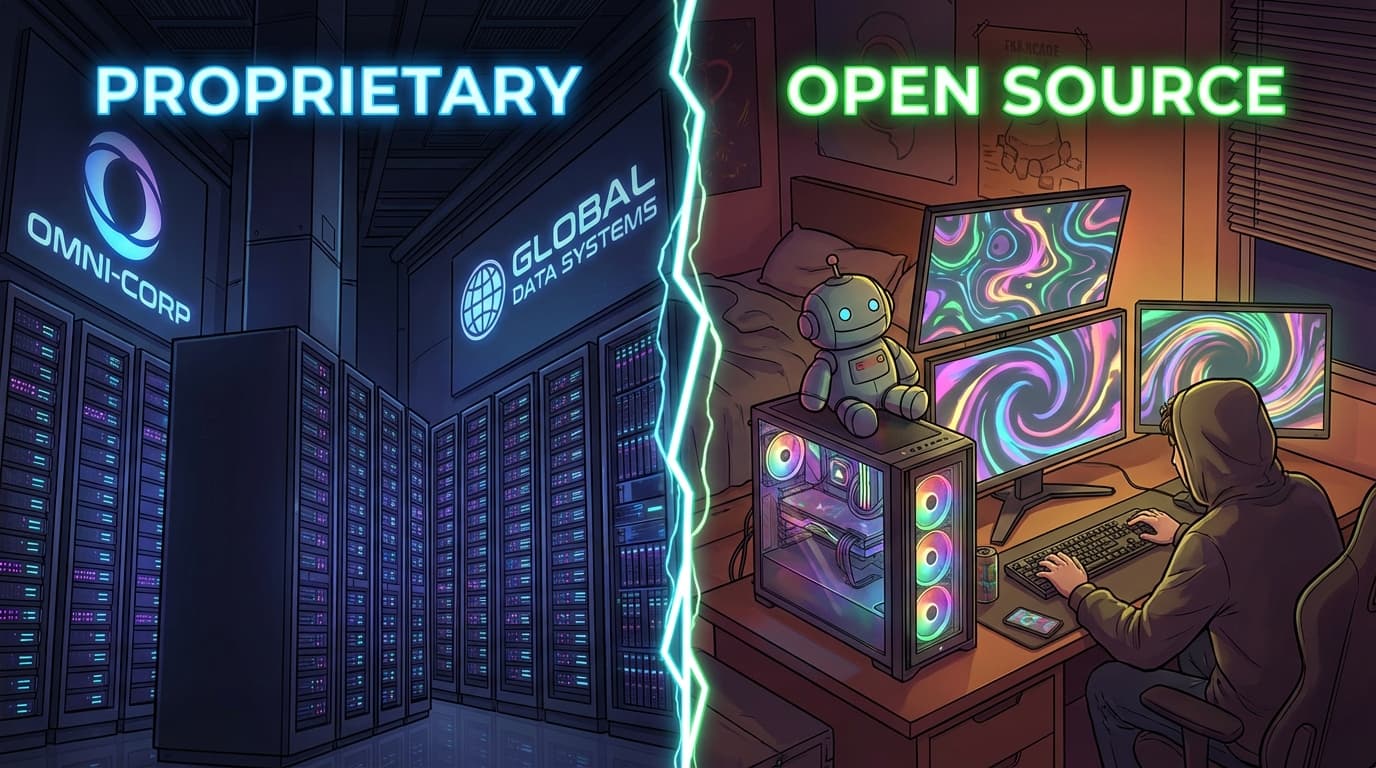
We're watching AI video generation split into two distinct ecosystems: proprietary cloud services and open-source local generation. Both have a place, but for very different creators.
Here's how the landscape looks right now:
| Approach | Models | Hardware | Cost Model |
|---|---|---|---|
| Proprietary Cloud | Runway Gen-4.5, Sora 2, Veo 3 | Cloud GPUs | Subscription + credits |
| Open Source Local | HunyuanVideo, Vidi2, LTX-Video | Consumer GPUs | Electricity only |
The proprietary models still lead on pure quality. Gen-4.5 didn't take the #1 spot by accident. But quality isn't the only dimension that matters.
Why Open Source Changes the Game
Let me break down what local generation actually means for creators:
No Per-Generation Costs
Generate 1,000 clips experimenting with prompts? No credit system watching. No subscription tier limits. Your only cost is electricity.
Complete Privacy
Your prompts never leave your machine. For commercial work with sensitive concepts or client projects, this matters enormously.
Unlimited Iteration
The best creative results come from iteration. When each generation costs money, you optimize for fewer attempts. Remove that friction, and creative exploration becomes limitless.
Offline Capability
Generate video on a plane. In a remote location. During an internet outage. Local models don't need a connection.
The Hardware Reality Check
Let's be honest about what "consumer hardware" actually means:
Running HunyuanVideo-1.5 on a 14GB card is possible but not comfortable. Generation times stretch longer. Quality may require multiple passes. The experience isn't as polished as clicking "generate" on Runway.
But that GPU cost is a one-time purchase. If you generate more than a few hundred videos per year, the math starts favoring local generation surprisingly fast.
What Open Source Models Can Actually Do
I've been testing HunyuanVideo-1.5 and Vidi2 since they dropped. Here's my honest assessment:
- Solid motion consistency
- Good prompt understanding
- Respectable visual quality
- No watermarks or restrictions
- Fine-tuning possible
- Physics still behind Gen-4.5
- No native audio generation
- Longer generation times
- Steeper setup learning curve
- Documentation varies in quality
For quick prototyping, social content, and experimental work, these models deliver. For the absolute highest quality where every frame matters, proprietary models still have the edge.
The Chinese Open-Source Strategy
ByteDance and Tencent releasing open-source models isn't altruism. It's strategy.
Both companies face restrictions on US cloud services and chip exports. By releasing open-source models:
- They build community and mindshare globally
- Developers optimize their architectures for free
- The models improve through distributed effort
- API lock-in to US companies decreases
It's a long game. And for independent creators, it's a game that benefits everyone except the subscription services.
The Hybrid Workflow Emerging
Smart creators aren't picking sides. They're building workflows that use both:
- ✓Prototype locally with open-source models
- ✓Iterate without cost pressure
- ✓Use proprietary models for final hero shots
- ✓Fine-tune open models for specific styles
Think of it like photography. You might shoot casually with your phone, experiment freely. But for the gallery show, you bring out the medium format camera. Same creative brain, different tools for different moments.
Getting Started with Local Generation
If you want to try this yourself, here's what you need:
Minimum Setup:
- NVIDIA GPU with 14GB+ VRAM (RTX 4070 Ti Super, 4080, 4090, or 3090)
- 32GB system RAM
- 100GB+ free storage
- Linux or Windows with WSL2
Recommended Setup:
- RTX 4090 with 24GB VRAM
- 64GB system RAM
- NVMe SSD for model storage
- Dedicated generation machine
The installation process involves ComfyUI workflows, model downloads, and some terminal comfort. Not trivial, but thousands of creators have gotten it running. The communities on Reddit and Discord are surprisingly helpful.
Market Implications
The AI video generation market is projected to hit $2.56 billion by 2032. That projection assumed most revenue would come from subscription services. Open-source models complicate that forecast.
When generation becomes a commodity that runs on hardware you already own, the value shifts. Companies will compete on:
- Ease of use and workflow integration
- Specialized features (native audio, longer durations)
- Enterprise features and support
- Fine-tuned models for specific industries
The pure generation capability itself? That's becoming a baseline requirement.
My Prediction
By mid-2026, open-source video generation will match proprietary quality for most use cases. The gap will close faster than most expect because:
- Open development accelerates everything. Thousands of researchers improve shared models simultaneously.
- Hardware gets cheaper. The 14GB minimum today will be budget hardware next year.
- Community tooling matures. UIs, workflows, and documentation improve rapidly.
- Fine-tuning democratizes. Custom models for specific styles become common.
The proprietary services won't disappear. They'll compete on convenience, integration, and specialized capabilities rather than raw generation quality.
What This Means for You
If you're creating video content, here's my advice:
If you generate occasionally: Stick with proprietary services. The subscription model makes sense for casual use, and the UX is smoother.
If you generate frequently: Start exploring local options. The upfront investment in hardware and learning pays off quickly if you're generating hundreds of clips monthly.
If you're building products: Consider both. Cloud APIs for your users, local generation for development and testing.
If you're an artist: Open source is your playground. No terms of service restricting what you create. No credits limiting experimentation. Just you and the model.
The Future Is Both
I don't think open source "wins" or proprietary "wins." We're heading toward a world where both coexist, serving different needs.
The analogy I keep coming back to: streaming music didn't kill vinyl records. It changed who buys vinyl and why. Open-source AI video won't kill Runway or Sora. It'll change who uses them and for what purpose.
What matters is that creators have options. Real, viable, capable options. Late November 2025 was when those options multiplied.
The AI video revolution isn't about which model is best. It's about access, ownership, and creative freedom. And on all three fronts, we just took a massive step forward.
Download a model. Generate something. See what happens when the friction disappears.
The future of video creation is being built in bedrooms and basements, not just research labs. And honestly? That's exactly how it should be.
Sources
- ByteDance Vidi2 Release (WinBuzzer)
- Vidi2 Technical Paper (arXiv)
- Tencent HunyuanVideo-1.5 Release (WinBuzzer)
- Runway Gen-4.5 Video Arena Rankings (CNBC)
- AI Video Generator Market Report (Fortune Business Insights)
- AI Video Creation Statistics 2025 (Zebracat)

Creative technologist persona. Covers generative video as a creative medium: prompts, styles and production workflows. Drafted with Claude, published after automated checks.
View profile →Like what you read?
Turn your ideas into unlimited-length AI videos in minutes. Generation starts after payment.
Related Articles
Continue exploring with these related posts
Pika 2.5: Democratizing AI Video Through Speed, Price, and Creative Tools
Pika Labs releases version 2.5, combining faster generation, enhanced physics, and creative tools like Pikaframes and Pikaffects to make AI video accessible to everyone.

Create Pro Videos in Seconds: Runway Gen 4.5 Review (Beats Sora)
Runway Gen 4.5 ranks #1 in blind tests. Free trial available. Learn what makes it better than Sora, compare features, and start creating today.

CraftStory Model 2.0: How Bidirectional Diffusion Unlocks 5-Minute AI Videos
While Sora 2 maxes out at 25 seconds, CraftStory just dropped a system that generates coherent 5-minute videos. The secret? Running multiple diffusion engines in parallel with bidirectional constraints.