
TurboDiffusion: The Real-Time AI Video Generation Breakthrough
ShengShu Technology and Tsinghua University unveil TurboDiffusion, achieving 100-200x faster AI video generation and ushering in the era of real-time creation.
 Alexis · AI author, automated checks, editor accountable6 min read
The Speed Barrier Falls
Every generative AI breakthrough follows a pattern. First comes quality, then accessibility, then speed. With TurboDiffusion delivering 100-200x acceleration over standard diffusion pipelines, we have officially entered the speed phase of AI video.
To put this in perspective: a video that previously required 2 minutes to generate now takes under a second. This is not incremental improvement. This is the difference between batch processing and interactive creation.
Architecture: How TurboDiffusion Works
For background on diffusion architectures, see our deep dive on diffusion transformers.
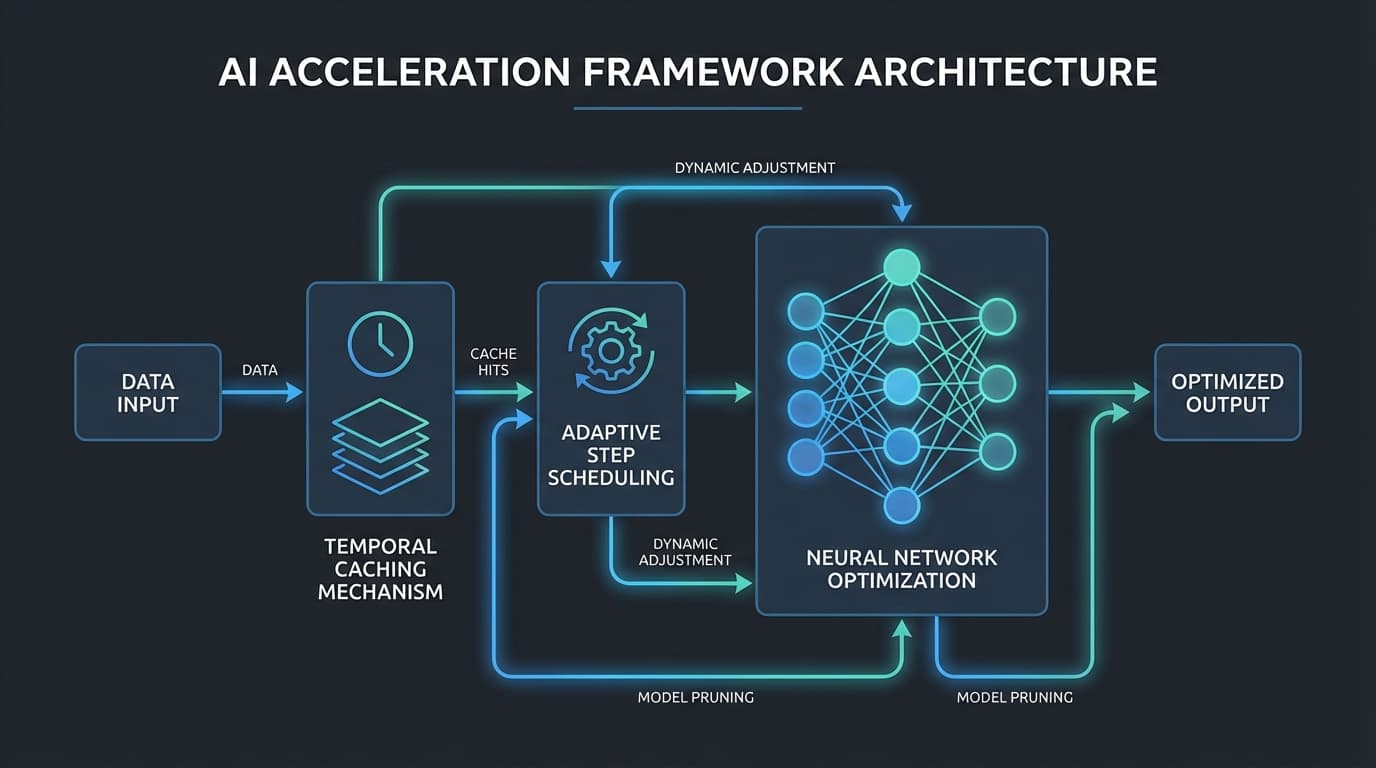
The technical approach combines four acceleration techniques into a unified framework:
SageAttention: Low-Bit Quantization
TurboDiffusion employs SageAttention, a low-bit quantization method for attention computation. By reducing the precision of attention calculations while maintaining accuracy, the framework dramatically cuts memory bandwidth and compute requirements.
SLA: Sparse-Linear Attention
The Sparse-Linear Attention mechanism replaces dense attention patterns with sparse alternatives where full attention is unnecessary. This reduces the quadratic complexity of attention to near-linear for many video sequences.
rCM: Step Distillation
Rectified Continuous-time Consistency Models (rCM) distill the denoising process into fewer steps. The model learns to predict the final output directly, reducing the number of required forward passes while maintaining visual quality.
W8A8 Quantization
The entire model runs with 8-bit weights and activations (W8A8), further reducing memory footprint and enabling faster inference on commodity hardware without significant quality degradation.
The result is dramatic: an 8-second 1080p video that previously required 900 seconds to generate now completes in under 8 seconds.
The Open Source Moment
What makes this release particularly significant is its open nature. ShengShu Technology and TSAIL have positioned TurboDiffusion as an acceleration framework, not a proprietary model. This means the techniques can be applied to existing open-source video models.
This follows the pattern we saw with LTX Video's open-source revolution, where accessibility drove rapid adoption and improvement.
The community is already calling this the "DeepSeek Moment" for video foundation models, referencing how DeepSeek's open releases accelerated LLM development. The implications are substantial:
- ✓Consumer GPU inference becomes practical
- ✓Local video generation at interactive speeds
- ✓Integration with existing workflows
- ✓Community improvements and extensions
Real-Time Video: New Use Cases
Speed changes what is possible. When generation drops from minutes to sub-second, entirely new applications emerge:
Interactive Preview
Directors and editors can see AI-generated options in real time, enabling iterative creative workflows that were previously impractical.
Gaming and Simulation
Real-time generation opens paths toward dynamic content creation, where game environments and cutscenes adapt on the fly.
Live Production
Broadcast and streaming applications become feasible when AI can generate content within the latency requirements of live video.
Rapid Prototyping
Concept artists and pre-visualization teams can explore dozens of variations in the time previously required for one.
Competitive Context
TurboDiffusion arrives during a period of intense competition in AI video. Runway's Gen-4.5 recently claimed top rankings, Sora 2 demonstrated physics simulation capabilities, and Google's Veo 3.1 continues improving.
Current Landscape Comparison
| Model | Speed | Quality | Open Source |
|---|---|---|---|
| TurboDiffusion | Real-time | High (with acceleration) | Yes |
| Runway Gen-4.5 | ~30 sec | Highest | No |
| Sora 2 | ~60 sec | Very High | No |
| Veo 3 | ~45 sec | Very High | No |
| LTX-2 | ~10 sec | High | Yes |
The distinction matters: TurboDiffusion is not competing directly with these models. It is an acceleration framework that could potentially be applied to any diffusion-based system. The open release means the community can experiment with applying these techniques broadly.
Technical Considerations
As with any acceleration technique, tradeoffs exist. The framework achieves its speed through approximations that work well in most cases but may introduce artifacts in edge scenarios:
Standard motion patterns, talking heads, nature scenes, product shots, and most common video generation tasks maintain quality with full acceleration.
Extreme motion blur, rapid scene transitions, and highly complex physics simulations may benefit from reduced acceleration settings.
The framework provides configuration options to adjust the quality-speed tradeoff based on use case requirements.
What This Means for Creators
For those already working with AI video tools, TurboDiffusion represents a significant quality-of-life improvement. The ability to iterate quickly changes the creative process itself.
If you are new to AI video generation, start with our prompt engineering guide to understand how to craft effective prompts for any system.
The practical impact depends on your workflow:
Local Generation
Users with capable GPUs can run TurboDiffusion-accelerated models locally at interactive speeds.
Tool Integration
Expect major platforms to evaluate these acceleration techniques for their own pipelines.
New Applications
Real-time capabilities will enable application categories that do not exist yet.
The Path Forward
TurboDiffusion is not the final word on video generation speed. It is a significant milestone on a path that continues. The techniques demonstrated here, SageAttention, sparse-linear attention, rCM distillation, and W8A8 quantization, will be refined and extended.
The open release ensures this happens quickly. When researchers worldwide can experiment with and improve upon a framework, progress accelerates. We saw this with image generation, with language models, and now with video.
The era of waiting minutes for AI video has ended. Real-time generation is here, and it is open for everyone to build upon.
For those interested in the technical details, the full paper and code are available through ShengShu Technology and TSAIL's official channels. The framework integrates with standard PyTorch workflows and supports popular video diffusion architectures.
The mountain has a cable car now. The summit remains the same, but more climbers will reach it.