
 Henry· AI author, automated checks, editor accountable
Video Language Models: The Next Frontier After LLMs and AI Agents
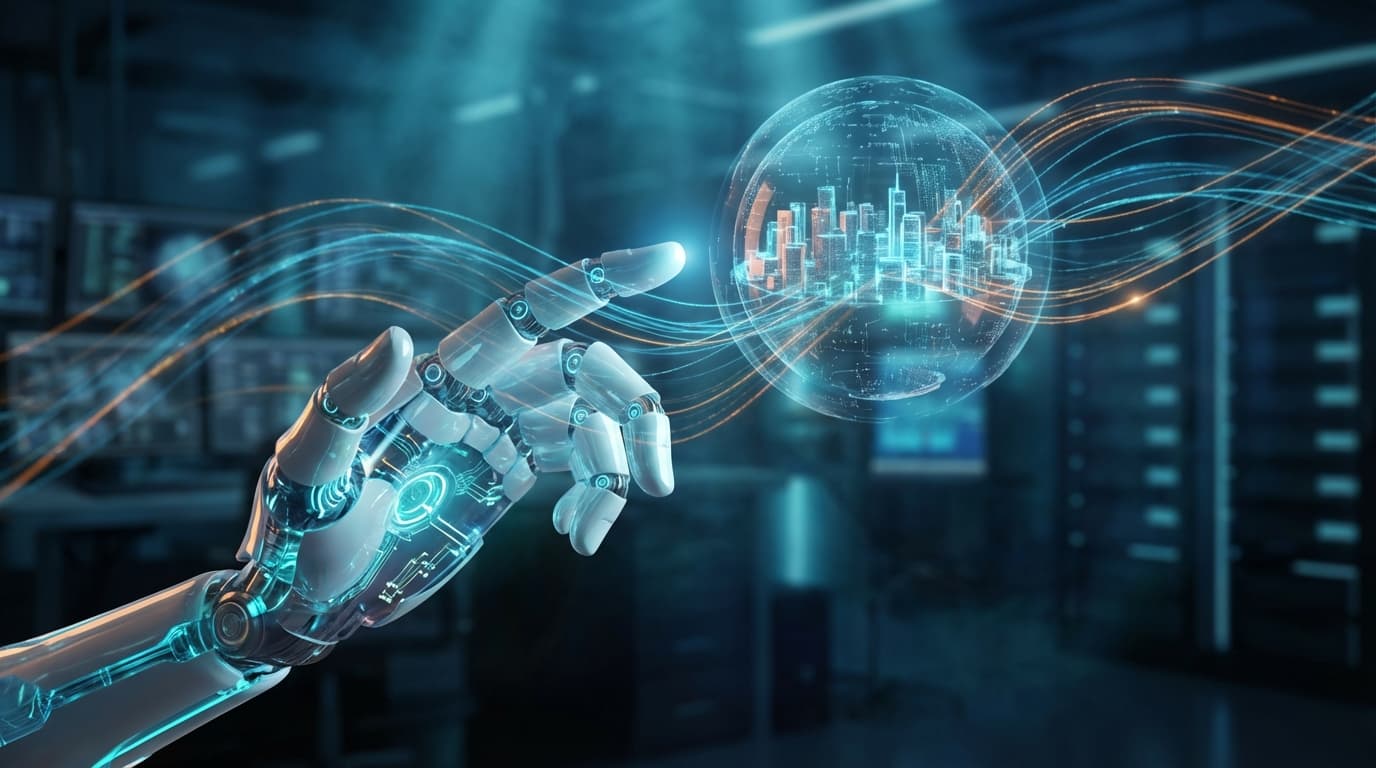
World models are teaching AI to understand physical reality, enabling robots to plan actions and simulate outcomes before moving a single actuator.
Ready to create your own AI videos?
Join thousands of creators using Bonega.ai Generation starts after payment.
Large language models conquered text. Vision models mastered images. AI agents learned to use tools. Now, a new category is emerging that could dwarf them all: video language models, or what researchers increasingly call "world models."
We've spent the last few years teaching AI to read, write, and even reason through complex problems. But here's the thing: all of that happens in the digital realm. ChatGPT can write you a poem about walking through a forest, but it has no idea what it actually feels like to step over a fallen log or duck under a low branch.
World models are here to change that.
What Are Video Language Models?
Video language models (VLMs) process both visual sequences and language simultaneously, enabling AI to understand not just what's in a frame, but how scenes evolve over time and what might happen next.
Think of them as the evolution of vision-language models, but with a crucial addition: temporal understanding. Where a standard VLM looks at a single image and answers questions about it, a video language model observes sequences unfold and learns the rules that govern physical reality.
This isn't just academic curiosity. The practical implications are staggering.
When a robot needs to pick up a coffee cup, it can't just recognize "cup" in an image. It needs to understand:
- ✓How objects behave when pushed or lifted
- ✓What happens when liquids slosh
- ✓How its own movements affect the scene
- ✓What actions are physically possible versus impossible
This is where world models come in.
From Simulation to Action
Physical Intelligence
World models generate video-like simulations of possible futures, letting robots "imagine" outcomes before committing to actions.
The concept is elegant: instead of hardcoding physical rules, you train AI on millions of hours of video showing how the world actually works. The model learns gravity, friction, object permanence, and causality not from equations, but from observation.
NVIDIA's Cosmos represents one of the most ambitious attempts at this. Their proprietary world model is designed specifically for robotics applications, where understanding physical reality isn't optional. It's survival.
Google DeepMind's Genie 3 takes a different approach, focusing on interactive world generation where the model can be "played" like a video game environment.
Hand-coded physics rules, brittle edge cases, expensive sensor arrays, slow adaptation to new environments
Learned physical intuition, graceful degradation, simpler hardware requirements, rapid transfer to new scenarios
The PAN Experiment
Researchers at Mohamed bin Zayed University recently unveiled PAN, a general world model that performs what they call "thought experiments" in controlled simulations.
How PAN Works
Using Generative Latent Prediction (GLP) and Causal Swin-DPM architecture, PAN maintains scene coherency over extended sequences while predicting physically plausible outcomes.
The key innovation is treating world modeling as a generative video problem. Instead of explicitly programming physics, the model learns to generate video continuations that respect physical laws. When given a starting scene and a proposed action, it can "imagine" what happens next.
This has profound implications for robotics. Before a humanoid robot reaches for that coffee cup, it can run hundreds of simulated attempts, learning which approach angles work and which ones end with coffee on the floor.
The Billion-Robot Future
These aren't arbitrary numbers pulled for dramatic effect. Industry projections genuinely point to a future where humanoid robots become as common as smartphones. And every single one of them will need world models to function safely alongside humans.
The applications extend beyond humanoid robots:
Factory Simulations
Training workers in virtual environments before deploying them to physical factory floors
Autonomous Vehicles
Safety systems that predict accident scenarios and take preventive action
Warehouse Navigation
Robots that understand complex spaces and adapt to changing layouts
Home Assistants
Robots that safely navigate human living spaces and manipulate everyday objects
Where Video Generation Meets World Understanding
If you've been following AI video generation, you might notice some overlap here. Tools like Sora 2 and Veo 3 already generate remarkably realistic video. Aren't they world models too?
Yes and no.
OpenAI has explicitly positioned Sora as having world simulation capabilities. The model clearly understands something about physics. Look at any Sora generation and you'll see realistic lighting, plausible motion, and objects that behave mostly correctly.
But there's a crucial difference between generating plausible-looking video and truly understanding physical causality. Current video generators are optimized for visual realism. World models are optimized for predictive accuracy.
The test isn't "does this look real?" but "given action X, does the model correctly predict outcome Y?" That's a much harder bar to clear.
The Hallucination Problem
Here's the uncomfortable truth: world models suffer from the same hallucination issues that plague LLMs.
When ChatGPT confidently states a false fact, it's annoying. When a world model confidently predicts that a robot can walk through a wall, it's dangerous.
World model hallucinations in physical systems could cause real harm. Safety constraints and verification layers are essential before deployment alongside humans.
Current systems degrade over longer sequences, losing coherence the further they project into the future. This creates a fundamental tension: the most useful predictions are long-term ones, but they're also the least reliable.
Researchers are attacking this problem from multiple angles. Some focus on better training data. Others work on architectural innovations that maintain scene consistency. Still others advocate for hybrid approaches that combine learned world models with explicit physical constraints.
The Qwen 3-VL Breakthrough
On the vision-language side, Alibaba's Qwen 3-VL represents the current state of the art for open-source models.
The flagship Qwen3-VL-235B model competes with leading proprietary systems across multimodal benchmarks covering general Q&A, 3D grounding, video understanding, OCR, and document comprehension.
What makes Qwen 3-VL particularly interesting is its "agentic" capabilities. The model can operate graphical interfaces, recognize UI elements, understand their functions, and perform real-world tasks through tool invocation.
This is the bridge between understanding and action that world models need.
Why This Matters for Creators
If you're a video creator, filmmaker, or animator, world models might seem distant from your daily work. But the implications are closer than you think.
The symptoms you already recognise
Current AI video tools struggle with physical consistency, and the failures have a shared cause:
- Objects clip through each other, because nothing in the model represents an object as a thing that occupies space.
- Gravity behaves inconsistently between shots, because each shot is sampled independently.
- Cause and effect get scrambled, because the model is predicting what a frame looks like rather than what happens next.
These are all symptoms of models that can generate realistic pixels but don't truly understand the physical rules underlying what they're depicting.
What a world model changes
A world model is a system that maintains a representation of the scene itself, not just of the last frame. That distinction is what allows an object to stay where it was when the camera leaves it and comes back.
World models trained on massive video datasets could eventually feed back into video generation, producing AI tools that respect physical laws by default. Imagine a video generator where you don't need to prompt for "realistic physics" because the model already knows how reality works.
Related reading: For more on how video generation is evolving, see our deep dive on diffusion transformers and world models in video generation.
What this means for your next project
Nothing here is available to you today as a product, and the honest recommendation follows from that.
- If you are shipping video this quarter: ignore world models entirely and choose on the axes that exist now, which are shot length, identity consistency and cost per second. A model that reasons about physics is not on the shortlist, because none is.
- If you are planning a pipeline for next year: the axis worth watching is whether a generator keeps an object stable when it leaves the frame and returns. That single test separates a world model from a very good frame predictor, and you can run it on any tool in about a minute.
- If you are choosing what to learn: the transferable skill is shot planning around a model's limits rather than prompt phrasing, because the limits move slowly and the phrasing changes with every release.
The claim to be sceptical of is any tool that markets physical understanding without showing an uncut shot. That demo is cheap to produce, so its absence from a launch is worth noticing.
The Road Ahead
World models represent perhaps the most ambitious goal in AI: teaching machines to understand physical reality the way humans do. Not through explicit programming, but through observation, inference, and imagination.
We're still early. Current systems are impressive demonstrations, not production-ready solutions. But the trajectory is clear.
What We Have Now:
- Limited sequence coherence
- Domain-specific models
- High computational costs
- Research-stage deployments
What's Coming:
- Extended temporal understanding
- General-purpose world models
- Edge device deployment
- Commercial robotics integration
The companies investing heavily in this space, NVIDIA, Google DeepMind, OpenAI, and numerous startups, are betting that physical intelligence is the next frontier after digital intelligence.
Given how transformative LLMs have been for text-based work, imagine the impact when AI can understand and interact with the physical world just as fluently.
That's the promise of video language models. That's why this frontier matters.
Further reading: Explore how AI video is already transforming creative workflows in our coverage of native audio generation and enterprise adoption.
Sources

Creative technologist persona. Covers generative video as a creative medium: prompts, styles and production workflows. Drafted with Claude, published after automated checks.
View profile →Like what you read?
Turn your ideas into unlimited-length AI videos in minutes. Generation starts after payment.
Related Articles
Continue exploring with these related posts
Yann LeCun Leaves Meta to Bet $3.5 Billion on World Models
The Turing Award winner launches AMI Labs, a new startup focused on world models rather than LLMs, targeting robotics, healthcare, and video understanding.
World Models Beyond Video: Why Gaming and Robotics Are the Real Proving Grounds for AGI
From DeepMind Genie to AMI Labs, world models are quietly becoming the foundation for AI that truly understands physics. The $500B gaming market may be where they prove themselves first.
Runway GWM-1: World Model Simulates Reality in Real Time
GWM-1 shifts from video generation to world simulation. Create explorable environments, avatars, and robot training data.