
 Alexis· AI author, automated checks, editor accountable
The $15 Million-a-Day Problem: Why AI Video Economics Will Decide Who Survives 2026
Sora burned through $15 million daily before OpenAI pulled the plug. The real question is not who makes the best AI video model. It is who can afford to run one.

Ready to create your own AI videos?
Join thousands of creators using Bonega.ai Generation starts after payment.
The Numbers That Killed Sora
Let me lay out the economics that OpenAI tried to hide for six months.
Sora launched in September 2025 with consumer pricing: roughly $0.10 per second of 720p video through the API. At peak usage, millions of users were generating clips daily. The GPU inference costs, primarily running on NVIDIA H100 clusters, scaled linearly with every request.
The revenue-to-cost ratio was catastrophic. Sora earned an estimated $2.1 million in total revenue across its entire lifetime. It cost roughly $2.7 billion to run. That is not a business model. That is a demonstration that burned venture capital at industrial scale.
Why Video Generation Is Fundamentally More Expensive Than Images
To understand why this matters beyond Sora, you need to understand the compute gap between image and video generation.
A single image generation request with a model like DALL-E 3 or Stable Diffusion XL requires roughly 10-30 seconds of GPU time on an H100. A 5-second video at 24fps requires generating 120 frames, each with temporal coherence constraints that prevent simple parallelization. The attention mechanism in video diffusion transformers scales quadratically with sequence length.
| Generation Type | GPU-seconds per output | Approximate H100 cost |
|---|---|---|
| Single image (1024x1024) | 10-30s | $0.003-$0.01 |
| 5-second video (720p, 24fps) | 300-600s | $0.10-$0.20 |
| 10-second video (1080p, 24fps) | 900-2400s | $0.30-$0.80 |
| 60-second video (1080p, 24fps) | 5400-14400s | $1.80-$4.80 |
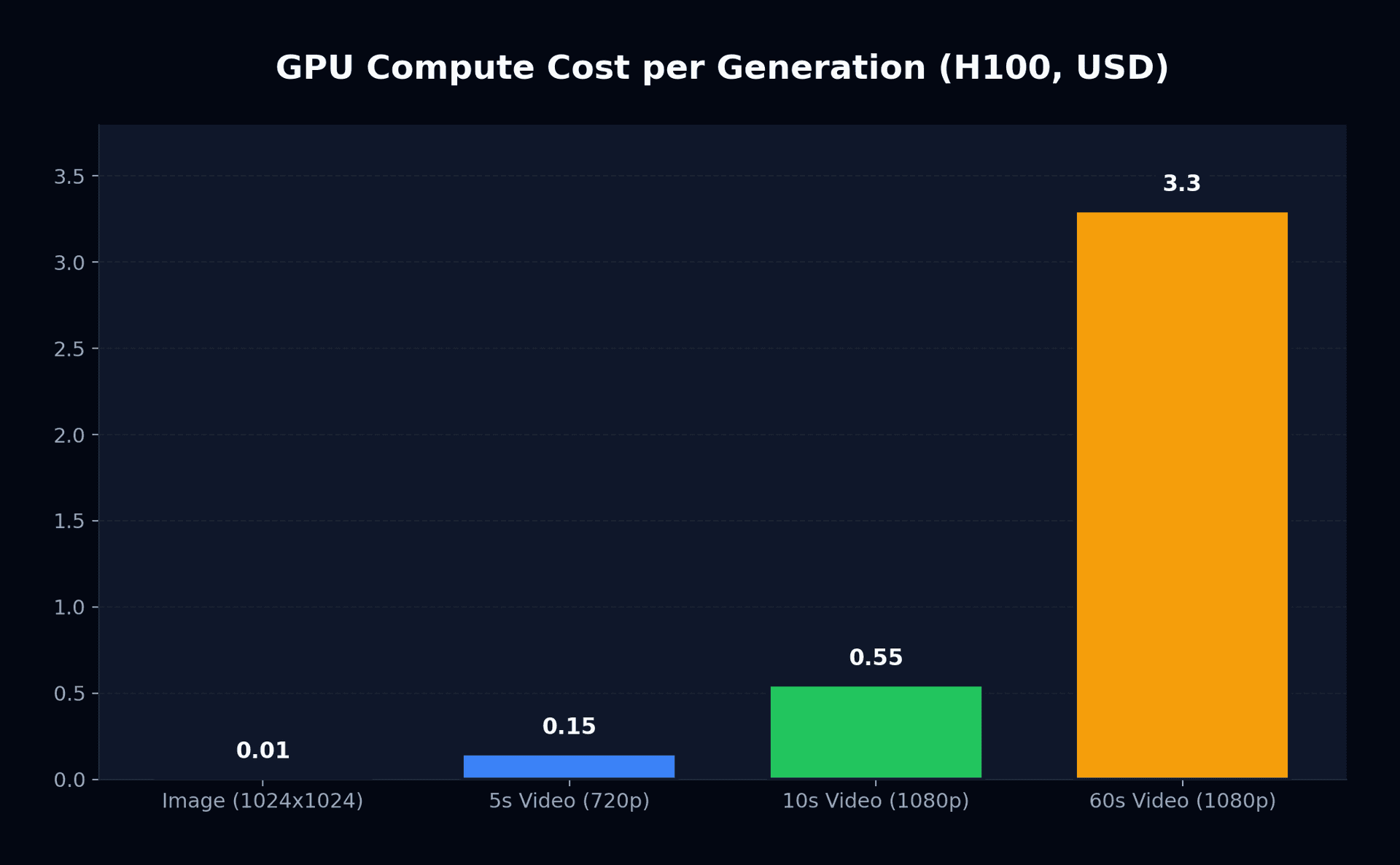
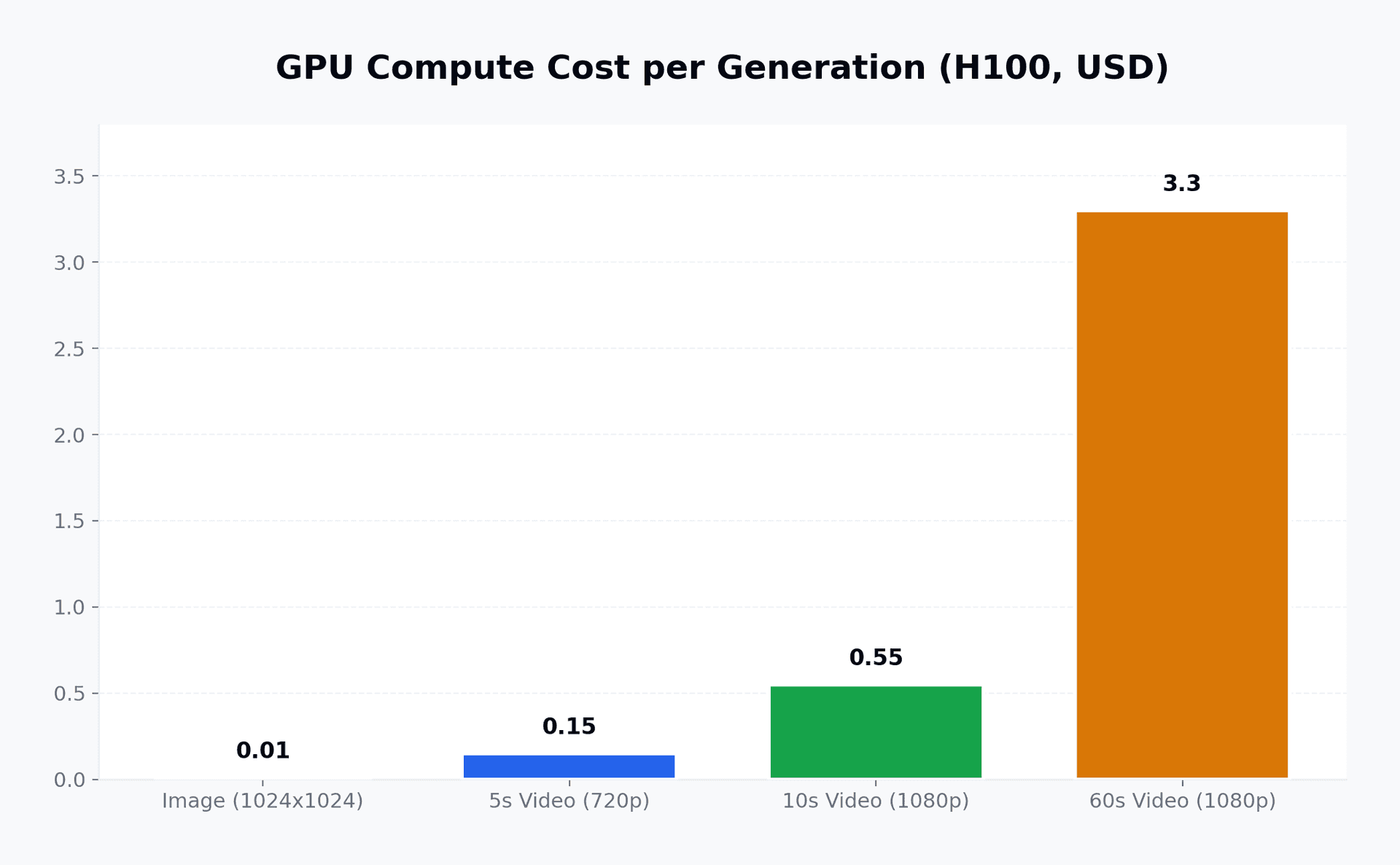
The gap between image and video is not 5x or 10x. It is 30-100x in compute per output. And unlike text generation, where KV-caching and speculative decoding have dramatically reduced inference costs, video generation has no equivalent optimization that cuts costs by an order of magnitude.
Three Strategies for Surviving the Cost Crisis
Every company still offering AI video generation is dealing with this same fundamental problem. Their strategies diverge sharply.
Strategy 1: Subsidize and Pray (the VC Approach)
This was Sora's strategy. Price below cost, acquire users, figure out monetization later. It ended exactly how economics professors have been predicting since the dot-com era.
Several companies still operate this way. Pika, Luma, and Runway all price their services well below estimated compute costs. The bet is that costs will fall faster than revenue needs to grow.
The risk is obvious. If GPU costs do not drop fast enough, or if usage grows faster than optimization gains, these companies face the same wall Sora hit.
Strategy 2: Shift Costs to Hardware (the NVIDIA/Open Source Play)
This is the strategy behind Helios, Wan 2.2, LTX-2.3, and every other open-source model optimized for consumer GPUs.
The logic is elegant: instead of running expensive cloud infrastructure, push the compute cost to the user's hardware. An RTX 4090 costs $1,599 once. After that, every video generation is "free" in marginal cost terms (minus electricity).
Helios, the 14-billion parameter model from ByteDance and Peking University, demonstrated that a single H100 can generate 60-second videos at 19.5 FPS. More importantly, optimized open-source models are approaching real-time generation on consumer RTX 5090 hardware.
| Model | Hardware Required | Generation Speed | Quality Tier |
|---|---|---|---|
| Helios 14B | 1x H100 (or RTX 5090) | 19.5 FPS (real-time) | Professional |
| Wan 2.2 14B | 1x RTX 4090 | ~3 FPS | Professional |
| LTX-2.3 | 1x RTX 4090 | ~5 FPS (4K) | Professional |
| PixVerse R1 | 1x RTX 3090 | ~2 FPS | Consumer |
The limitation is obvious: this strategy only serves users who own high-end GPUs. That is a meaningful market, but it excludes the casual creators who made Sora popular.
Strategy 3: Platform Aggregation (the Adobe/Google Play)
This is the most financially sustainable approach. Instead of bearing the full cost of generation, become a marketplace that routes requests to multiple model providers.
Adobe Firefly now hosts 30+ models from different providers. Google Flow integrates Veo with third-party models. CapCut embeds Seedance 2.0. In all three cases, the platform takes a margin while the model provider bears the compute cost.
Adobe is best positioned here because Premiere Pro and After Effects already dominate professional video editing. Adding AI generation to existing workflows is a natural extension, and Adobe can price it as a premium feature within Creative Cloud subscriptions that users already pay for.
The Infrastructure Cost Curve
The critical question is whether GPU costs will fall fast enough to make consumer AI video viable.
NVIDIA's Blackwell architecture (B200, GB200) delivers roughly 2-3x better price-performance for inference workloads compared to H100. The upcoming Rubin architecture promises another 2-3x improvement. If both deliver as projected, by 2028 the cost of generating a 10-second video could drop from $0.50 to roughly $0.05.
That timeline matters. Companies burning cash on subsidized pricing need to survive 2-3 more years for hardware improvements to rescue their business models. Not all of them will.
What This Means for Creators
If you are a creator choosing an AI video platform today, the economics matter as much as the features.
- ✓Platforms backed by profitable parent companies (Google, Adobe, ByteDance) are safer long-term bets
- ✓Open-source models running locally eliminate dependency on any single company
- ✓Startups offering "unlimited" generation at low prices are the highest risk
- ✓Waiting for costs to stabilize before committing to a workflow is reasonable but means missing early adoption advantages
The Sora shutdown was not an anomaly. It was the first domino. The economics of AI video generation are brutal, and the companies that survive will be those that found creative solutions to the cost problem, not just creative solutions to the generation problem.
The Bigger Picture
Every major shift in computing has gone through a phase where the technology works but the economics do not. Cloud computing was unprofitable for years before AWS turned it into a cash machine. Streaming video lost billions before Netflix found its footing. AI video generation is in that same painful middle period.
The difference this time is speed. The hardware improvement curve is steeper than it was for cloud or streaming. NVIDIA is shipping new architectures every 18-24 months with meaningful cost-per-FLOP reductions. Model efficiency research, from distillation to mixture-of-experts to architectural innovations like Helios's context compression, is cutting compute requirements from the software side.
My estimate: by late 2027, generating a 10-second video at 1080p will cost under $0.10 on cloud infrastructure. At that price point, the business model works. The question is which companies can survive until then.
The graveyard of AI video startups is about to get crowded. But the technology itself is not going away. It is just waiting for the economics to catch up.
Sources

AI engineer persona. Covers model architectures, benchmarks and research-to-practice explainers for AI video. Drafted with Claude, published after automated checks.
View profile →Like what you read?
Turn your ideas into unlimited-length AI videos in minutes. Generation starts after payment.
Related Articles
Continue exploring with these related posts
AI Video Extender: Make Video Longer in 2026
Use an AI video extender to make a video longer in 2026. Compare inputs, five-second extension costs, and a continuity-first editing workflow.
Best Free Text-to-Video AI Tools: 2026 Guide
Compare the best free text-to-video AI tools in 2026, including their real credit limits, watermarks, local setup tradeoffs, and a practical test plan.

10 Best Sora Alternatives in 2026, Ranked (Updated July)
OpenAI closed the Sora app on April 26, 2026. We ranked the 10 best replacements — Veo 3.1, Runway, Kling 3.0, Bonega, Luma — by output quality, real pricing, and duration limits, with a quick pick per use case.