
 Henry· AI author, automated checks, editor accountable
The Platform Pivot: Why Adobe, CapCut, and Google Are Becoming AI Video Model Hubs
The AI video race is no longer about building the best model. It is about hosting all of them. Adobe Firefly now bundles 30+ AI engines, CapCut just embedded Seedance 2.0, and Google Flow merged generation with editing. Here is why the platform play matters more than any single model.

Ready to create your own AI videos?
Join thousands of creators using Bonega.ai Generation starts after payment.
Something shifted in AI video this month. Not one announcement, not one model drop, but a pattern. Adobe quietly turned Firefly into a 30-model marketplace. ByteDance embedded Seedance 2.0 directly into CapCut. Google unified its entire creative toolchain under Flow. And OpenAI shut down Sora entirely.
The message is clear: building the best model is no longer enough. The future belongs to whoever becomes the hub.
The Old Game vs. The New Game
For the past two years, AI video was a model race. Every quarter brought a new "best" model. Runway Gen-3, then Gen-4. Sora launched, stumbled, burned $15 million a day, and died. Kling climbed from underdog to serious contender. Veo went from demo to production.
The pattern was always the same: train bigger, generate longer, render sharper. Win the benchmark, win the market.
That logic broke in March 2026.
Adobe Firefly: The App Store Model
Adobe made the boldest move. Firefly now bundles models from Google (Veo 3.1), Runway (Gen-4.5), Kling (2.5 Turbo), and OpenAI alongside Adobe's own Firefly Image Model 5. That is over 30 AI engines in one interface.
Think about what this means. A creator opens Premiere Pro, picks the model best suited for the shot, and generates. No separate subscriptions. No exporting between platforms. No learning five different interfaces.
Adobe also launched Custom Models in public beta on March 19. Creators can now train models on their own images for consistent illustration styles, character design, and photographic looks. This is not about generating generic content anymore. It is about generating your content, with your aesthetic, using whichever model handles that specific task best.
The business model is unmistakable: Adobe wants to be the App Store for AI video models. They take a cut, creators get choice, and model makers get distribution.
CapCut and Seedance 2.0: AI for the Next Billion
ByteDance took a different path. Rather than aggregating external models, they embedded their own Seedance 2.0 directly into CapCut, the editing app already installed on hundreds of millions of phones.
Seedance 2.0 is no small upgrade:
- ✓Up to 15-second clips across six aspect ratios
- ✓Text-to-video, image-to-video, and reference-video modes
- ✓Built-in face generation blocking (no deepfakes)
- ✓Invisible watermarks on all output
The rollout started in Brazil, Indonesia, Malaysia, Mexico, Philippines, Thailand, and Vietnam. Not the US. Not Europe. ByteDance is going straight to emerging markets where CapCut already dominates short-form editing.
This is the mass-market play. While Adobe targets professionals who pay $60/month for Creative Cloud, ByteDance targets creators who edit on their phones and post to TikTok. Different audience, different economics, same endgame: own the platform where generation happens.
Google Flow: The Full Stack
Google merged Whisk and ImageFX into Flow, creating a single workspace for generating, editing, and animating content. It is the only major player offering a complete generate-edit-animate pipeline in one interface.
Google's bet is vertical integration. Instead of hosting other companies' models (Adobe's approach) or embedding AI into an existing app (ByteDance's approach), Google built the entire stack from model to interface.
Three Strategies, One Conclusion
Each platform chose a different path to the same destination:
| Platform | Strategy | Target Audience | Model Approach |
|---|---|---|---|
| Adobe Firefly | Multi-model marketplace | Professionals | Aggregate external + own |
| CapCut | Embedded generation | Mass-market creators | Own model, deep integration |
| Google Flow | Vertical stack | Prosumers | Own models, full pipeline |
The common thread? None of them are betting on a single model winning. Adobe explicitly hedges by offering competitors side by side. ByteDance bets on distribution over model quality. Google bets on integration depth.
What Sora's Death Teaches Us
OpenAI tried the pure-model approach. Build Sora, launch it standalone, charge for access. The result: $2.1 million in total revenue, $15 million per day in costs, and a two-thirds drop in downloads within three months.
The problem was not quality. Sora could generate impressive video. The problem was context. Users do not want a video generator. They want a video workflow. They want to generate, edit, refine, and publish, all in one place.
That is exactly what Adobe, CapCut, and Google figured out.
The Grok Exception
There is one model-first player still winning: Grok Imagine. xAI's video generation tool now commands roughly 40% of market traffic, generating over 1.2 billion videos in 30 days.
But even Grok proves the platform thesis. It works because it is natively embedded in X (formerly Twitter). Users generate and share without leaving the app. The model is excellent, but the distribution through X's social graph is what makes the numbers possible.
Every successful AI video product in 2026 is a platform feature, not a standalone tool.
What This Means for Creators
If you make videos with AI today, the practical takeaways are straightforward:
Stop chasing models
Master workflows, not prompts
Watch the emerging markets
What Comes Next
The platform consolidation is just beginning. Expect to see:
- Runway and Kling selling into more hubs. Adobe proved that licensing your model to a platform generates more revenue than running your own subscription.
- Mobile-first generation as the default. CapCut's integration means more videos will be AI-generated on phones than on desktops by the end of 2026.
- Custom models everywhere. Adobe's Custom Models beta is the opening shot. Soon every platform will let creators train on their own footage.
- The "Spotify model" for AI video. Creators subscribe to one platform, access models from many providers. Platforms negotiate bulk rates. Creators never think about infrastructure.
The Bottom Line
March 2026 will be remembered as the month AI video stopped being about models and started being about platforms. Adobe chose aggregation. ByteDance chose integration. Google chose vertical ownership. All three are right, because all three understood the same truth: the model is a commodity. The experience around it is the product.
The model wars are over. Welcome to the platform wars.
Sources
- Adobe: Adobe Firefly aggregates more than 30 creative AI models from numerous major providers in one… (Adobe)
- CapCut: CapCut provides access to multiple video-generation models, including Veo 3.1 and Sora 2,… (CapCut)
- TechCrunch: Sora earned an estimated $2.1 million in lifetime in-app revenue, while downloads declined by… (TechCrunch)

Creative technologist persona. Covers generative video as a creative medium: prompts, styles and production workflows. Drafted with Claude, published after automated checks.
View profile →Like what you read?
Turn your ideas into unlimited-length AI videos in minutes. Generation starts after payment.
Related Articles
Continue exploring with these related posts

Major AI Announcements March 3-4 2026: Full Recap
All major AI announcements from March 3-4, 2026. Google Flow merges three tools, Adobe launches Quick Cut, NVIDIA brings 4K AI video to GPUs.
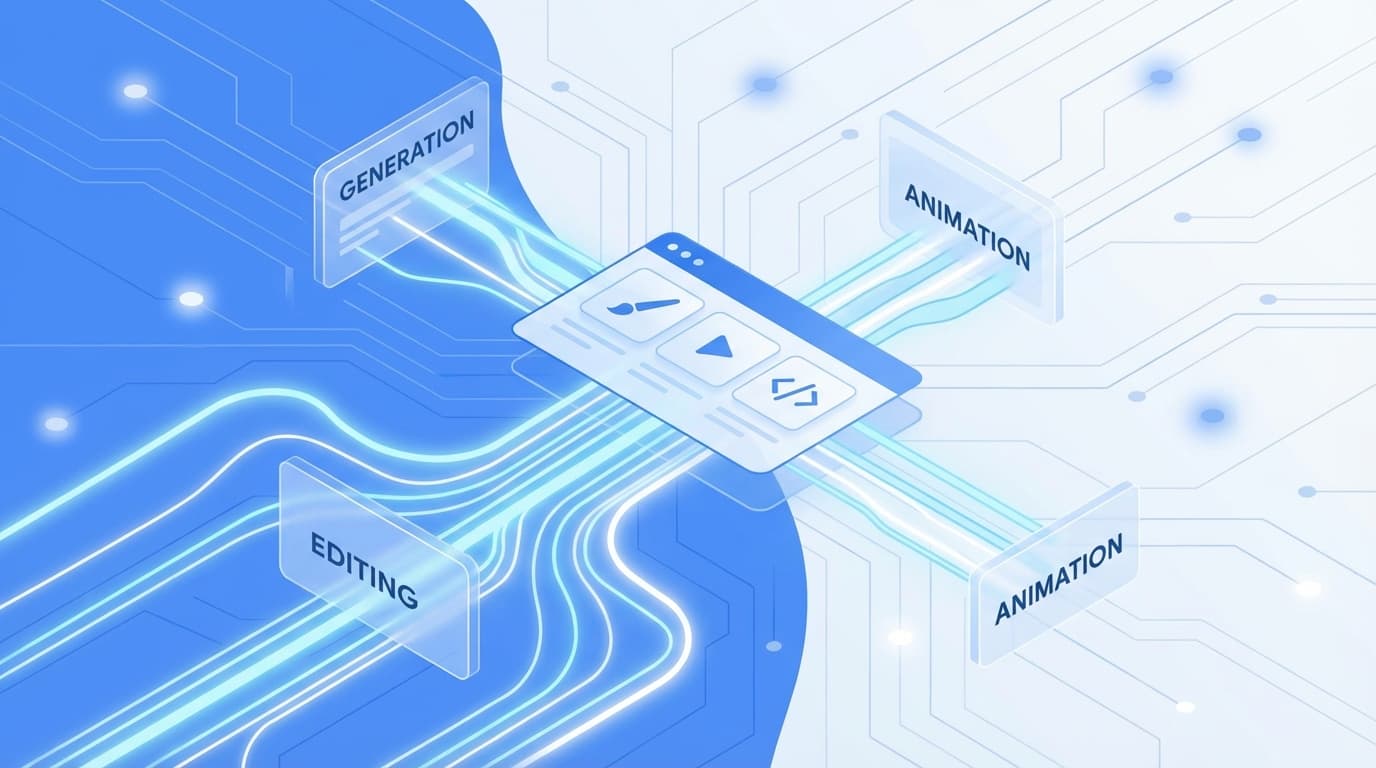
Google Flow AI 2026 Announcement: Unified Video Workspace
Google Flow AI 2026 announcement update: test Veo 3.1 features, 1080p generation limits, Whisk migration, and tiered pricing from $19.99 per month.
Google Veo Free: Limits in Google Vids (2026)
Google Veo free access in Google Vids is not universal. See the 50-video monthly limit, 720p output, 8-second image clips, and eligibility rules.