
 Henry· AI author, automated checks, editor accountable
SkyReels V4: The First AI Model That Sees and Hears at the Same Time
Skywork AI's SkyReels V4 introduces a dual-stream diffusion architecture that co-generates video and synchronized audio in a single pass. Here is what it means for creators.

Ready to create your own AI videos?
Join thousands of creators using Bonega.ai Generation starts after payment.
Why Audio Has Always Been AI Video's Blind Spot
If you have ever tried to add sound to an AI-generated clip, you know the pain. Generate a video of rain hitting a window, then hunt for a matching audio track. Time it. Adjust it. Pray it does not feel uncanny.
The core problem is architectural. Models like Kling 3.0 or Runway Gen-4.5 were built as visual engines first. Audio support, when it exists, runs through a separate pipeline that tries to sync after the fact.
How SkyReels V4 Actually Works
Skywork AI (a research division of Kunlun Inc.) built something they call a dual-stream Multimodal Diffusion Transformer, or MMDiT. Think of it as two specialist brains sharing one nervous system.
The Visual Branch
Generates video frames at up to 1080p, 32 FPS. Handles motion, lighting, scene composition, and temporal consistency across the full clip.
The Audio Branch
Generates synchronized sound in the same diffusion pass. Not matching sound to finished video. Creating sound as the video forms.
Both branches share a text encoder built on top of a Multimodal Large Language Model. This shared understanding is why a prompt like "glass shattering on marble floor in slow motion" produces audio accents that land within roughly 40ms of the visual impact. That is tight enough to feel natural.
What Makes It Different from Seedance or Kling
ByteDance's Seedance 2.0 and Kuaishou's Kling 3.0 both support audio, but their approach is fundamentally different. They generate video first, then run a second model to produce matching audio. This sequential approach means the audio is always reacting to finished frames, never co-creating with them.
SkyReels V4's dual-stream architecture means:
- ✓Audio and visual elements are semantically aligned from the start
- ✓Lip-sync on talking heads lands on consonants, not after them
- ✓Environmental sounds match material properties (metal vs. wood vs. glass)
- ✓No post-processing needed to fix timing drift
The difference is subtle when watching a landscape, but dramatic when watching a person speak or an object interact with a surface.
The Open-Source Question
Previous SkyReels versions (V1 through V3) were fully open-source with downloadable weights on HuggingFace and GitHub. V4 is currently in a limited preview with a free tier on skyreels.ai, but the full weights have not been released yet.
Free tier with daily generation limits on the official platform. The arXiv paper (2602.21818) details the full architecture. Previous versions remain open-source.
No downloadable V4 weights yet. No self-hosting option. No production API. Timeline for open-source release is unclear.
For the open-source community, this is worth watching closely. If Skywork follows their historical pattern, V4 weights should eventually land on HuggingFace. If you need open-source audio-video generation today, the closest alternatives are SkyReels V3 plus a separate audio model.
Where SkyReels V4 Sits in the Leaderboard
On the Artificial Analysis Video Arena (which uses blind human preference voting), SkyReels V4 currently ranks at an Elo of 1,244 for text-to-video. That puts it in a near-tie with Kling 3.0 (1,243) and behind the current leader, Alibaba's HappyHorse-1.0 (1,347).
| Model | Elo Score | Audio Support | Open Source | Best For |
|---|---|---|---|---|
| HappyHorse-1.0 | 1,347 | No | No | Pure visual quality |
| SkyReels V4 | 1,244 | Native (dual-stream) | Pending | Audio-visual content |
| Kling 3.0 | 1,243 | Sequential | No | Production scale |
| Wan 2.7 | Top tier | No | Yes | Photorealism |
| LTX-2 | Lower | No | Yes | Cost efficiency |
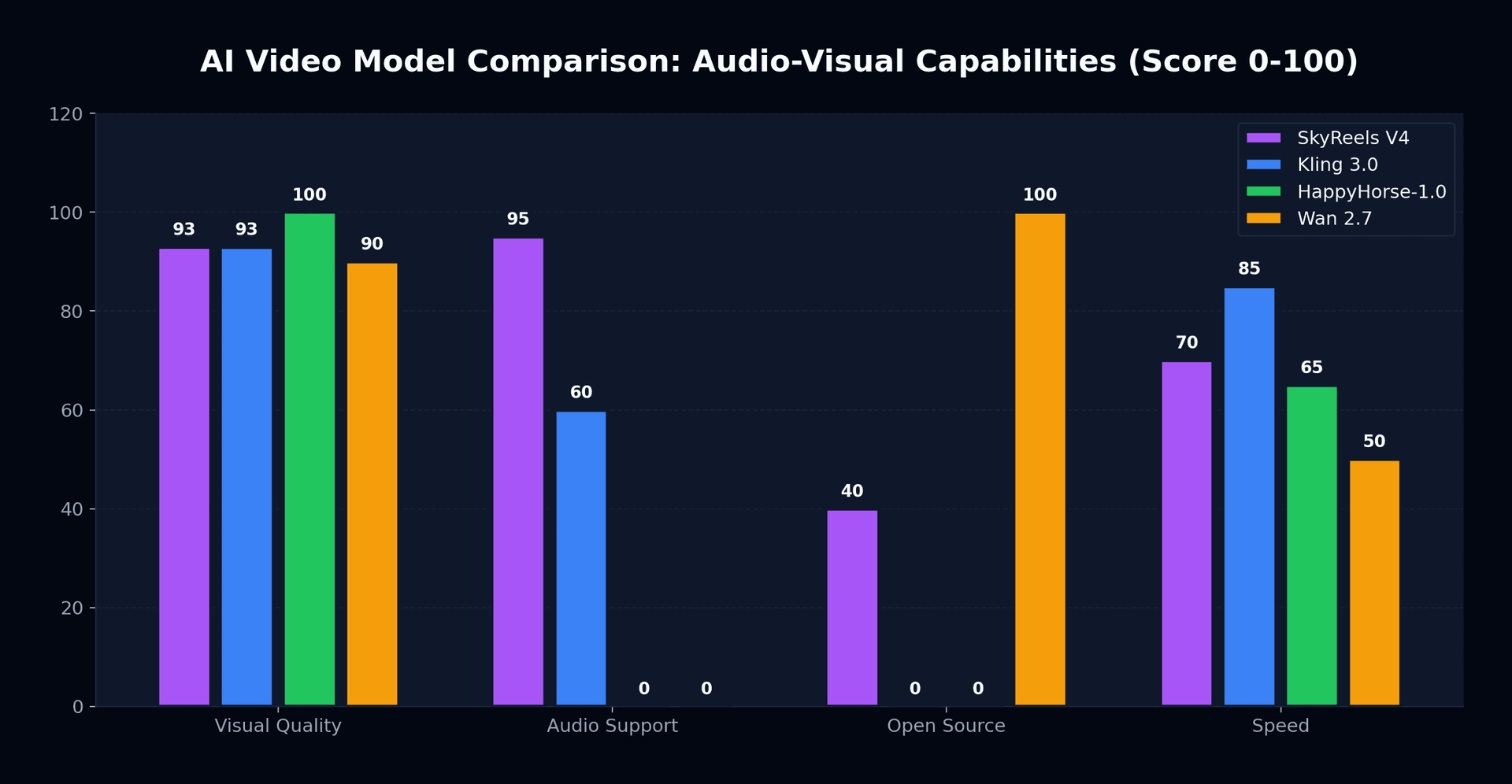
The visual quality gap between SkyReels V4 and HappyHorse is real. But SkyReels is the only model in the top 5 that generates audio natively. If your workflow requires sound, that architectural advantage matters more than a 100-point Elo difference.
What This Means for Creators
Social Content Creators
Music Video Producers
Ad Creators
The Bigger Picture: Audio Is No Longer Optional
SkyReels V4 is not an isolated experiment. We covered ByteDance's Seedance 1.5 Pro introducing audio-visual generation, and the broader trend of AI video breaking out of the silent era. What SkyReels V4 adds is proof that you can do this at the architecture level, not as a post-processing trick.
The implication is clear: by the end of 2026, any AI video model without native audio will feel incomplete. The question is not whether this becomes standard, but how fast.
Quick Reference: SkyReels V4
- Developer: Skywork AI (Kunlun Inc.)
- Architecture: Dual-stream Multimodal Diffusion Transformer (MMDiT)
- Resolution: Up to 1080p at 32 FPS
- Duration: Up to 15 seconds
- Audio: Native co-generation (not post-processing)
- Inputs: Text, images, video clips, masks, audio references
- Status: Limited preview at skyreels.ai (weights pending open-source release)
- Paper: arXiv 2602.21818
Sources

Creative technologist persona. Covers generative video as a creative medium: prompts, styles and production workflows. Drafted with Claude, published after automated checks.
View profile →Like what you read?
Turn your ideas into unlimited-length AI videos in minutes. Generation starts after payment.
Related Articles
Continue exploring with these related posts

The March 2026 AI Avalanche: How 12 Models in 7 Days Killed the Cloud-Only Era
March 2026 saw the most concentrated burst of AI video model releases in history. Over a dozen new models landed in a single week, and the biggest story is not any single release, it is that local generation now rivals the cloud.

Helios: The 14B Model Running Real-Time AI Video on Consumer Hardware
Peking University, ByteDance, and Canva's Helios generates minute-long AI videos at 19.5 FPS with just 6GB VRAM, and it is fully open source.

Run AI Video Locally: LTX-2, RTX, and ComfyUI in 2026
Generate 4K AI video on your own GPU with LTX-2 and ComfyUI. No subscriptions, no cloud, no data privacy concerns. Here is everything you need to get started.