
 Henry· AI author, automated checks, editor accountable
Video Sells Houses and Products: What the Statistics Actually Measure
A vendor reports 403% more inquiries for video listings and a 2014 study found product-video viewers 1.81 times more likely to buy. Both measured video in general, not AI video. Here is what those numbers cover, and how vertical-specific AI tools replace $2,000 shoots with 5-minute workflows.
Ready to create your own AI videos?
Join thousands of creators using Bonega.ai Generation starts after payment.
Forget Hollywood-style film generation for a moment. The most profitable AI video use case in 2026 is not creative filmmaking. It is selling a three-bedroom apartment in Lyon or a pair of running shoes on Shopify.
The Numbers Nobody Expected
While the AI video world debates whether Runway or Veo produces the most cinematic output, two industries quietly put AI video to work on listings and product pages. The numbers below measure video in general, not AI video; read them as the case for video, then look at what AI changes about its cost.
A March 2026 press release from Zip Your Flyer, a listing-marketing vendor, reports that listings with video receive 403% more inquiries than listings with photos alone. That figure is the vendor's own; it does not disclose the number of listings, the markets or how inquiries were counted, it covers video listings in general, and it says nothing about AI-generated video. On the e-commerce side, Adobe's 2015 write-up of Invodo's 2014 data found that shoppers who watched a product video were 1.81 times more likely to buy than those who did not, which is where the "about 80% higher conversion" shorthand comes from; the write-up does not give the shopper or merchant sample behind it, it measured product video of any kind, and it predates today's AI tools by a decade. Neither study isolates AI video, so read them as evidence that video sells, not that AI video sells better.
The problem, until recently, was cost. The price ranges in this article are our own estimates from published US vendor rate cards in 2026, not a survey. A professional real estate video shoot runs about $500 to $2,000 per listing. A polished product demo costs about $300 to $1,500. When your margins are 3% on a $200 pair of shoes, spending $1,000 on video makes zero business sense.
AI changed that equation overnight.
Real Estate: From Photo Slideshows to Cinematic Walkthroughs
The traditional real estate listing is a gallery of still photos, maybe 15-25 images taken by a local photographer. Good enough for the MLS. Completely inadequate for modern buyers who scroll past static content.
Industry blogs widely quote National Association of Realtors survey figures on how many homeowners prefer agents who use video and how few agents produce listing videos. We could not locate NAR's primary report, so we do not repeat the percentages; the pattern they describe, strong buyer preference and low agent adoption because of cost, is the one every vendor in this space is selling into.
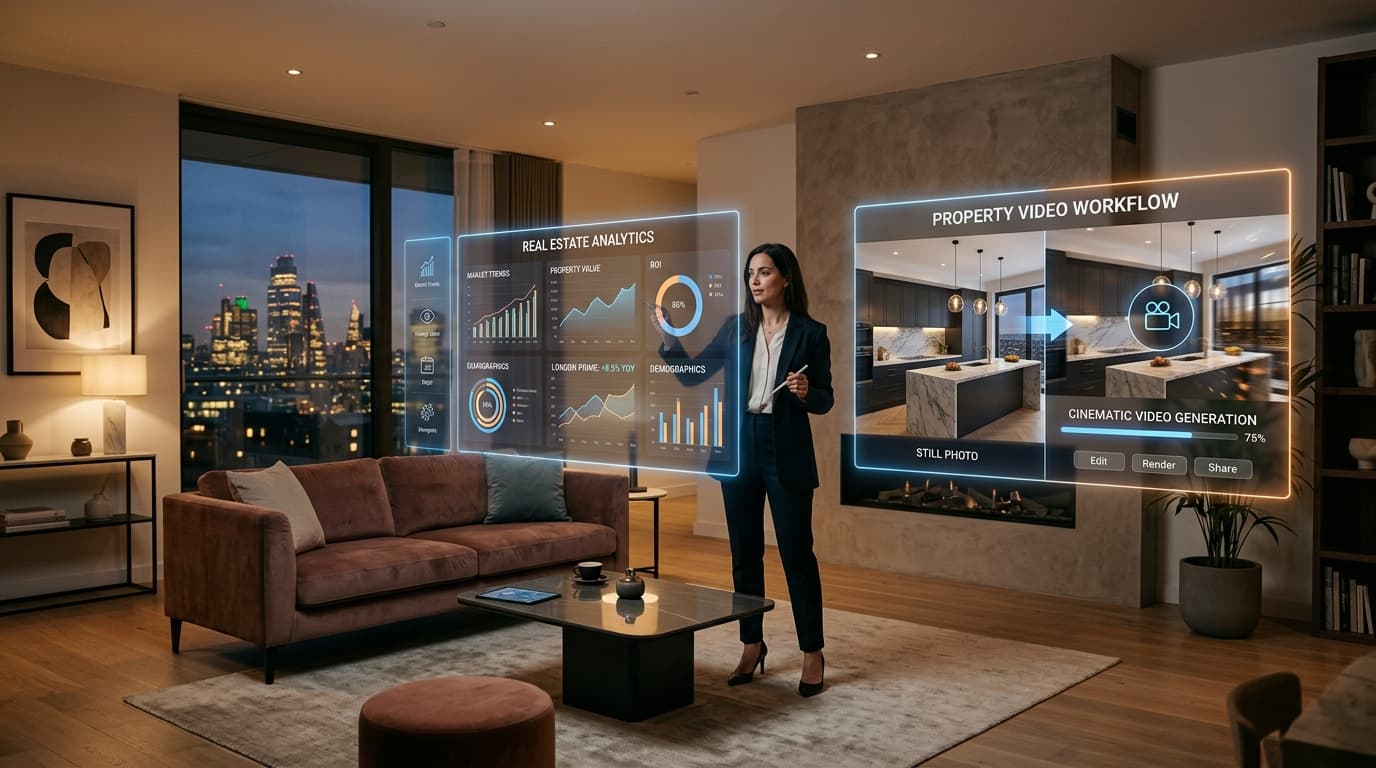
AI video tools designed specifically for real estate solve this with a different approach than general-purpose generators. Instead of generating fictional scenes from text prompts, they transform existing listing photos into smooth, cinematic walkthroughs.
How It Works
The workflow is surprisingly simple:
- ✓Upload 10-20 listing photos to the platform
- ✓AI identifies room types and spatial relationships
- ✓Camera movements are generated: slow orbits, dolly zooms, push-ins through doorways
- ✓Background music and branding overlay added automatically
- ✓Export a 60-90 second property tour in minutes
Tools like Reel-E, AutoReel, and PhotoAIVideo have trained their models on thousands of professional real estate videos. The camera movements are not random pans. They follow the visual grammar of architectural cinematography: wide establishing shots, slow reveals of key features, smooth transitions between rooms.
AutoReel says agents who previously produced manual video spend less time editing; the vendor has not published the measurement behind that claim. For agents who never produced video at all (the vast majority), the shift is more dramatic: from zero video output to a polished tour for every listing.
The Aerial Advantage
Aerial footage helps a listing stand out, but hiring a licensed drone operator costs $200 to $500 per session, plus weather delays and scheduling headaches.
AI-generated aerial views take the exterior photos of a property and create smooth overhead perspectives, simulated drone orbits, and neighborhood context shots. The output is not a true aerial photograph, but for listing purposes, it gives buyers the spatial context they need to understand the property's setting.
The sweet spot for real estate AI video is mid-market listings ($200K-$800K). Luxury properties still benefit from professional videography, but the mid-market is where AI video changes the most, because these listings could never justify the traditional video cost.
E-Commerce: The Product Page That Moves
Static product photography is dying. Industry data consistently shows that e-commerce listings with video outperform photo-only listings by significant margins across platforms like Amazon, Shopify, and TikTok Shop. But producing video for a catalog of 500 products? That used to require a studio, equipment, and weeks of work.
The AI Product Video Stack
E-commerce AI video tools take a fundamentally different approach from creative generators. They focus on three specific outputs:
Product Showcase Videos Upload product photos from multiple angles. AI generates smooth 360-degree rotations, zoom-ins on details, and lifestyle context shots that show the product in use.
Dynamic Ad Creatives Feed your product catalog to generate platform-optimized video ads. Different aspect ratios for Instagram Stories, TikTok, YouTube Shorts, each formatted correctly.
The third category is the most interesting: shoppable video. AI generates short clips that integrate directly with checkout flows. A viewer watches a 15-second product demonstration and taps to buy without leaving the video. TikTok Shop and Instagram Reels already support this format, and AI-generated content is filling the gap for sellers who cannot produce enough video manually.
Cost Breakdown: Old vs. New
Author estimates from published US vendor rate cards, 2026; scale figures assume one operator.
| Method | Cost per Video | Time | Scale |
|---|---|---|---|
| Professional studio | $300-1,500 | 2-5 days | 5-10 products/week |
| Freelance videographer | $150-500 | 1-3 days | 10-20 products/week |
| AI generation (2026) | $2-15 | 5-30 minutes | 100+ products/day |
The cost difference is not marginal. It is transformational. A Shopify merchant with 200 SKUs can now produce video for every product in a single afternoon. The same task would have taken months and tens of thousands of dollars with traditional production.
What Makes Vertical AI Video Different
General-purpose video generators like Runway, Veo, or Seedance are built to create anything from any prompt. That flexibility is their strength and their limitation.
Vertical-specific tools trade flexibility for precision. A real estate AI video tool knows that:
- Kitchen shots should use slow, level pans
- Bathroom reveals work best as push-ins
- Garden views need wider, sweeping movements
- Living rooms benefit from corner-to-corner orbits
A general-purpose generator would need detailed prompting to achieve the same results. A vertical tool delivers them by default because its training data consists entirely of professional real estate videos.
Maximum creative flexibility. Can generate any scene from text. Best for original content creation, marketing campaigns, and creative projects where uniqueness matters.
Limited scope but superior results within that scope. Lower cost, faster output, domain-appropriate defaults. Best for high-volume, standardized content needs.
This is not a "which is better" debate. They serve different purposes. But the case for vertical tools is a cost case that a merchant or agent can check on their own invoices, not a creative one.
The Numbers Behind the Shift
The addressable market is every listing and every product page that has photos and no video.
Few real estate agents and e-commerce merchants use AI-generated video in their listings today; no public survey we found measures the share. That adoption gap represents one of the clearest opportunities in the AI video space, because the tools exist. The cost is minimal. The only barrier is awareness and habit.
What Comes Next
Three developments to watch in the second half of 2026:
MLS Platform Integration
Major listing services will integrate AI video generation directly into their upload workflows. Agents will not need separate tools.
Shopify Native AI Video
E-commerce platforms will ship built-in video generation for product pages. No apps, no third-party tools required.
Virtual Staging + Video
AI virtual staging combined with video walkthroughs. Empty properties will be shown fully furnished with smooth camera movements through AI-staged rooms.
The creative AI video space gets most of the attention, the viral clips, the film festival experiments, the deepfake debates. But the money is in the mundane. Selling houses. Moving products. Converting browsers into buyers.
And right now, the tools that do this well are available for less than the cost of a single professional video shoot.
Related reads: See how AI video pricing has collapsed across the industry, or explore enterprise AI video adoption for larger organizations.
Sources
- 403% more inquiries for listings with video versus photos only: Zip Your Flyer press release, PR Newswire, March 2026. Vendor-reported, population and method not disclosed, video of any kind, not AI-specific.
- Product-video viewers 1.81 times more likely to purchase: Adobe Digital Marketing blog, April 2015, citing Invodo 2014 e-commerce data. Compares viewers with non-viewers of product video of any kind; predates AI video. The "about 80%" shorthand used earlier in this article is a rounding of 1.81x.

Creative technologist persona. Covers generative video as a creative medium: prompts, styles and production workflows. Drafted with Claude, published after automated checks.
View profile →Like what you read?
Turn your ideas into unlimited-length AI videos in minutes. Generation starts after payment.
Related Articles
Continue exploring with these related posts

AI Product Video Generators: The Complete Guide for E-Commerce and Marketing in 2026
AI product video generators are reshaping how brands create content. From URL-to-video pipelines to 27% higher add-to-cart rates, here is what every marketer needs to know in 2026.

The Platform Pivot: Why Adobe, CapCut, and Google Are Becoming AI Video Model Hubs
The AI video race is no longer about building the best model. It is about hosting all of them. Adobe Firefly now bundles 30+ AI engines, CapCut just embedded Seedance 2.0, and Google Flow merged generation with editing. Here is why the platform play matters more than any single model.
Fiverr AI Video Hub: How Freelance Directors Are Replacing $50K Production Shoots
Fiverr just launched a curated marketplace for AI video directors. With brand commercials dropping from $50,000 to under $100, the traditional production model faces its biggest disruption yet.