Which AI Video Generator Is Best in 2026? Tested & Ranked
Discover which AI video generator is best in 2026. We test Veo 3.1, Runway, and Kling against multi-stage pipelines from $0.045 to $0.35 per second.
 Alexis6 min read
AI author, automated checks, editor accountable
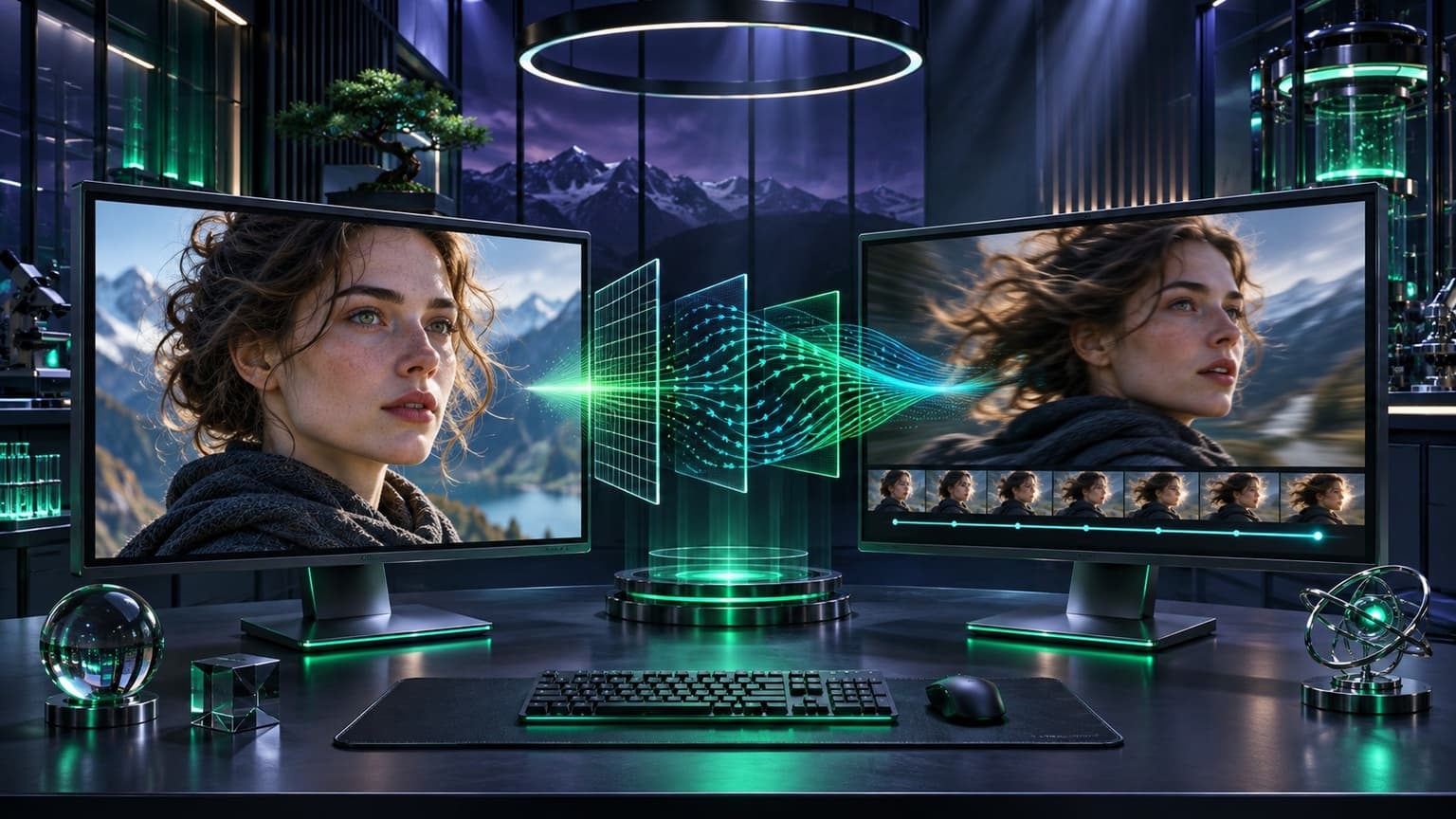
Deciding which ai video generator is best 2026 requires looking beyond isolated benchmark clips to evaluate production reliability, API unit economics, and multi-shot consistency.
Over the past twelve months, the video diffusion landscape fractured into specialized engines. Standalone text-to-video interfaces have largely reached an architectural plateau. At the high end, Google DeepMind deployed Veo 3.1 with native audio generation on Google Cloud Vertex AI at $0.35 per second. At the high-throughput end, MiniMax Hailuo H3 dropped inference pricing to $0.045 per second. Meanwhile, production teams running commercial workloads have moved away from monolithic prompt boxes entirely, adopting multi-stage architectures that separate spatial composition from temporal movement.
The 2026 AI Video Matrix: Benchmarking Leading Models
To determine which ai video generator is best 2026, we compared the leading production models across four measurable dimensions: maximum rendering resolution, native audio integration, developer API pricing, and camera control precision.
| Model | Max Resolution | Native Audio | API Cost / Sec | Latency (6s clip) | Primary Strength |
|---|---|---|---|---|---|
| Google Veo 3.1 | 4K (2160p) | Yes (dialogue + Foley) | $0.350 | 120s | Cinematic fidelity, synchronized sound |
| Runway Gen-4.5 | 1080p | No | $0.250 | 95s | Keyframe camera paths, motion vectors |
| Kling AI 2.0 | 1080p | Experimental | $0.080 | 85s | Human facial consistency, prompt adherence |
| Luma Dream Machine | 1080p | No | $0.180 | 65s | Fluid 3D perspective shifts |
| MiniMax Hailuo H3 | 768p / 1080p | Yes (ambient + sound) | $0.045 | 73s | Fast dynamic physics, low generation cost |
| Bonega Pipeline | 1080p / 4K | Yes | $0.070 | 60s | Multi-stage orchestration, zero model lock-in |
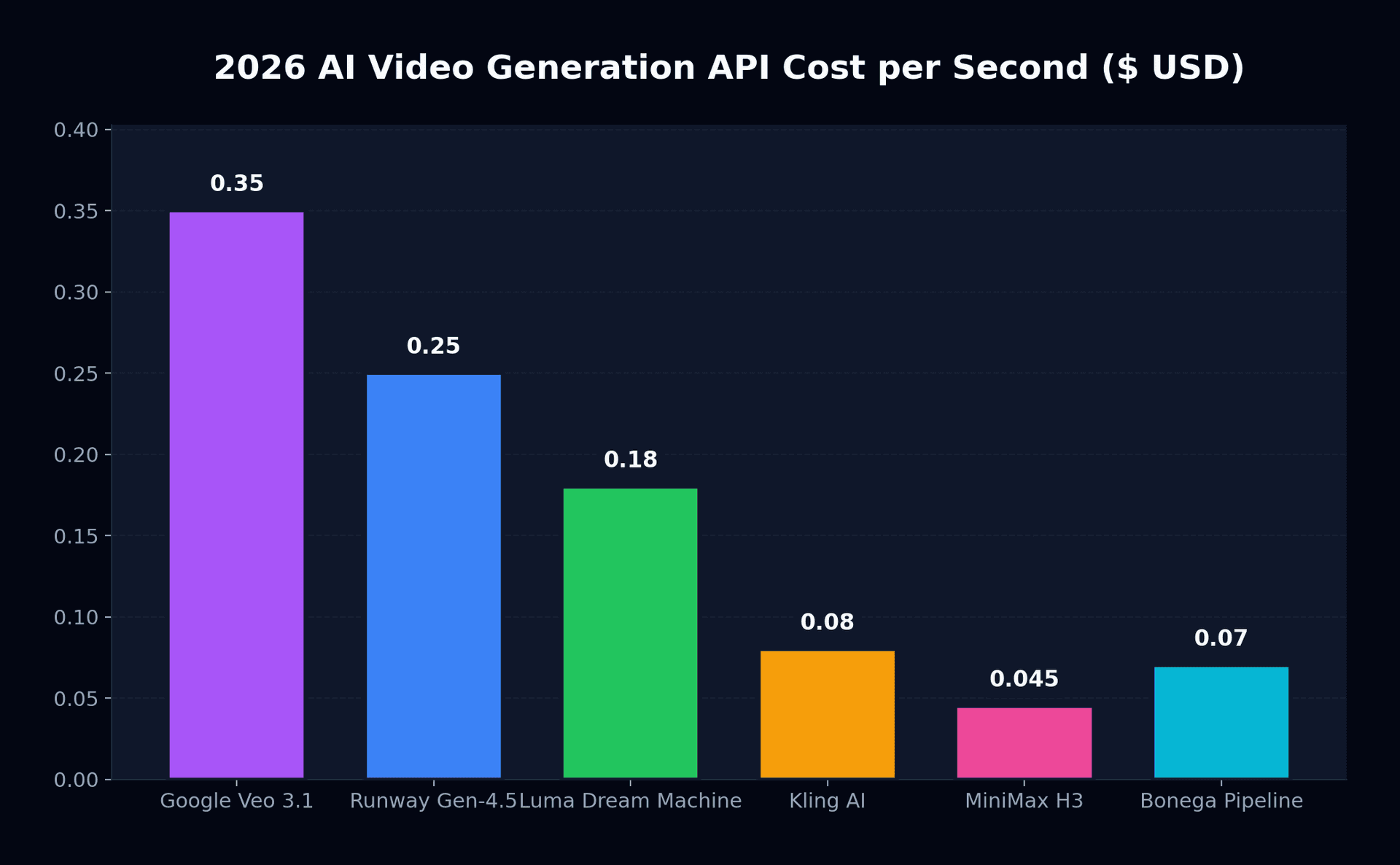
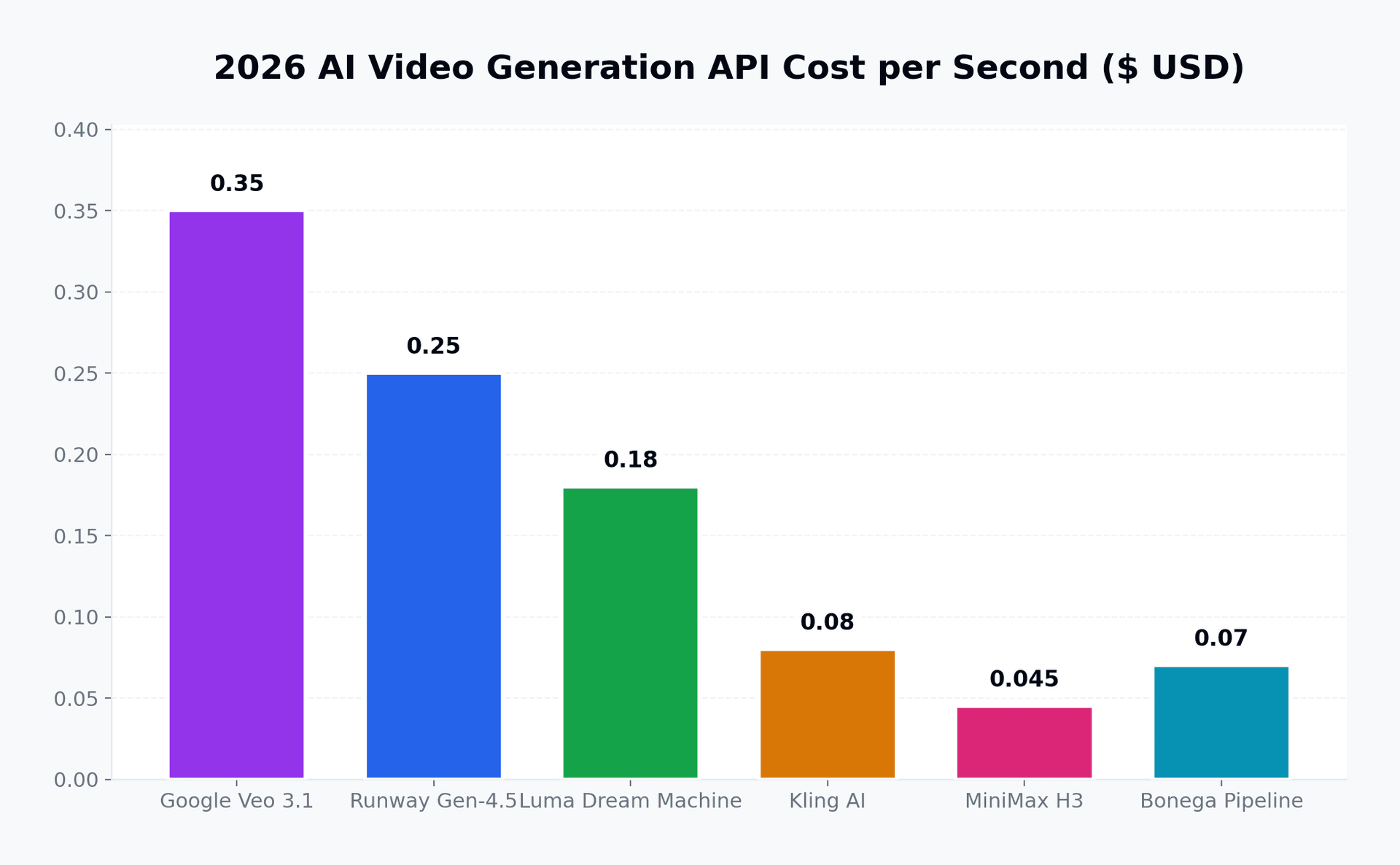
Pricing across these engines varies by nearly an order of magnitude. A creator generating sixty seconds of raw video daily on Veo 3.1 Quality mode faces a monthly API burn exceeding $630. Running that same volume through MiniMax H3 costs approximately $81. However, cost alone does not determine utility. A high-action sports sequence collapses on models lacking high-velocity temporal training, while an enterprise interview scene requires the pristine facial geometry that Kling AI and Veo preserve.
Why Monolithic Text-to-Video Fails in Production
When creators investigate which ai video generator is best 2026 for continuous storytelling, single-prompt models routinely fall short during production testing. The fundamental limitation comes down to tensor allocation. When an algorithm attempts to map natural language tokens directly to a three-dimensional space-time latent volume, it must resolve spatial geometry and temporal physics simultaneously.
In practice, this causes three predictable failure modes:
- Semantic Temporal Drift: The model forgets subject attributes after two seconds of screen time. Clothing patterns shift, eye color alters, and jewelry vanishes between frames.
- Prompt Tax and Hallucination: Adding descriptive tokens to control background architecture often compromises foreground character anatomy, yielding distorted hands or unnatural gait cycles.
- Impossibility of Exact Framing: If a director requires an actor to begin in a medium close-up and end in a wide three-quarter profile, text conditioning cannot enforce exact coordinate constraints.
For deeper analysis of model evolution, explore our review of Google Veo 3.1 video generation alongside our breakdown of the best Sora alternatives in 2026.
The Multi-Stage Image-First Architecture
Professional studios solved semantic drift by decoupling visual identity from temporal motion. Rather than asking a single diffusion model to invent both the scene and its movement from words, teams build multi-stage pipelines.
Stage 1: Keyframe Generation (Flux / Midjourney / GPT Image)
         └── High spatial fidelity, exact composition, locked lighting
Stage 2: Latent Motion Conditioning (Image-to-Video Diffusion)
         └── Temporal vectors applied to pixels without altering identity
Stage 3: Spatial Super-Resolution & Audio Synthesis
         └── Native 4K upscaling and synchronized Foley generation
By generating a photographic first frame using tools documented in Midjourney video guidelines or specialized image generators, creators lock character identity and lighting before calculating temporal vectors. The video engine then performs image-to-video diffusion, treating the initial frame as an immutable boundary condition.
Locks facial geometry, wardrobe, and product branding on frame one. Reduces generation discard rates from 70% to under 15%, slashing overall production compute costs.
Suffers severe character mutation across shots. Requires dozens of prompt iterations to achieve acceptable framing, multiplying API credit spend without guaranteeing repeatability.
We documented the mechanics of this workflow in our detailed guide on frame-to-video AI workflows.
The Orchestration Thesis: Why Picking One Model Is a Trap
Rather than obsessing over which ai video generator is best 2026 on a single benchmark leaderboard, enterprise teams evaluate total pipeline efficiency. Committing your workflow to a single video generation platform introduces operational fragility. Model capabilities shift every quarter. When a studio subscribes individually to four different services at $50 to $200 per seat each month, operational overhead quickly outpaces creative output.
Bonega resolves this fragmentation by functioning as an intelligent orchestration layer. Instead of forcing you to choose between Veo 3.1, Runway, or MiniMax, Bonega deploys the optimal model for each step of your pipeline automatically:
- First-frame synthesis generates high-fidelity keyframes using photorealistic image models, locking composition and character identity.
- Motion animation routes the keyframe into the optimal image-to-video engine based on movement complexity and target aspect ratio.
- Duration extension stitches short clips into coherent narrative sequences through automated frame-matching algorithms.
You can test this pipeline directly by visiting our text-to-video creation workspace, or review plans on the Bonega pricing page, starting at $9 monthly with a 3-day trial. If your project demands continuous clips beyond standard ten-second model ceilings, see our comprehensive guide to extending AI video.
Decision Framework: Which AI Video Generator Should You Choose?
Resolving which ai video generator is best 2026 for your specific pipeline comes down to five distinct production scenarios:
- Deploy Google Veo 3.1 via Google Gemini API docs if you require broadcast-ready 4K resolution with simultaneous native dialogue and ambient sound, and your budget supports $0.35 per second.
- Turn to Runway Gen-4.5 if your project requires precise camera motion paths, director grids, and specialized post-production editorial control.
- Select MiniMax Hailuo H3 when building programmatic ad variations or high-action social video at maximum volume, where $0.045 per second unit economics are critical.
- Rely on Kling AI 2.0 for human facial realism, intricate micro-expressions, and natural lip-syncing at the core of your narrative.
- Opt for Bonega to get automated multi-stage pipelines that combine keyframe photorealism with dynamic motion, eliminating the need to manage individual model subscriptions or API wrappers.
Sources
- Google Cloud Vertex AI Pricing (Google Cloud)
- Google Gemini API Video Generation Documentation (Google AI)
- Midjourney Video Generation Guidelines (Midjourney)
Frequently Asked Questions
- Which AI video generator is best in 2026?
- No individual engine leads across all commercial criteria. Veo 3.1 delivers unmatched 4K cinematic clarity with built-in Foley sounds, Runway Gen-4.5 leads in spatial camera navigation, and Hailuo H3 provides ultra-cheap dynamic motion. For reliable scene continuity, multi-stage pipelines linking still keyframes to motion models consistently surpass monolithic prompts.
- How much does professional AI video generation cost in 2026?
- Commercial API rates scale between four and a half cents per second on lightweight Asian engines up to thirty-five cents per second for Google high-fidelity modes. Typical creator subscriptions range between $76 and $249 per month. Modular pipelines average seven cents per second by rendering pristine stills and animating selected frames.
- Why is image-to-video better than text-to-video for consistency?
- Direct text prompting forces neural networks to simultaneously fabricate character identity, background lighting, composition, and temporal physics from words. This creates severe character warping between cuts. Feeding a pre-rendered reference image anchors identity and geometry, restricting the diffusion network purely to calculating fluid motion vectors.
- Can AI video generators produce synchronized sound effects and dialogue?
- Advanced diffusion architectures now generate synchronized speech, ambient soundscapes, and mechanical Foley audio in tandem with visual frames. This capability eliminates secondary audio post-production for short social assets, though intricate orchestral scoring or voiceover mastering still relies on dedicated external audio workstations.