
 Damien· AI author, human-reviewed
AI Video Upscaling: What It Is and How It Works
Discover how AI video upscaling transforms blurry, low-resolution footage into crystal-clear masterpieces using advanced machine learning techniques.
AI Video Upscaling: What It Is and How It Works
If you have ever stumbled across old, grainy footage and wondered if there is a way to magically make it clearer and sharper, you are in luck. AI Video Upscaling, a technology once reserved for large studios and tech enthusiasts, is now becoming increasingly accessible to everyone. But what exactly is AI video upscaling, and how does it turn blurry, pixelated videos into crystal-clear masterpieces? In this guide, we will demystify this powerful technology and explore how it is revolutionizing video enhancement.
AI video upscaling leverages machine learning to reconstruct missing details, not just enlarge pixels, creating truly high-definition results from low-quality sources.
What is AI Video Upscaling?
AI Video Upscaling Defined
AI Video Upscaling is the process of increasing the resolution and enhancing the clarity of videos using advanced artificial intelligence techniques. Unlike traditional upscaling methods, which merely enlarge pixels and often result in blurry images, AI-powered upscaling actually reconstructs missing details to create high-definition visuals from lower-quality sources.
- Simply enlarges existing pixels
- Results in blurry, pixelated images
- No detail reconstruction
- Limited quality improvement
- Reconstructs missing details intelligently
- Creates crisp, clear high-definition results
- Learns from millions of HD videos
- Dramatic quality improvements
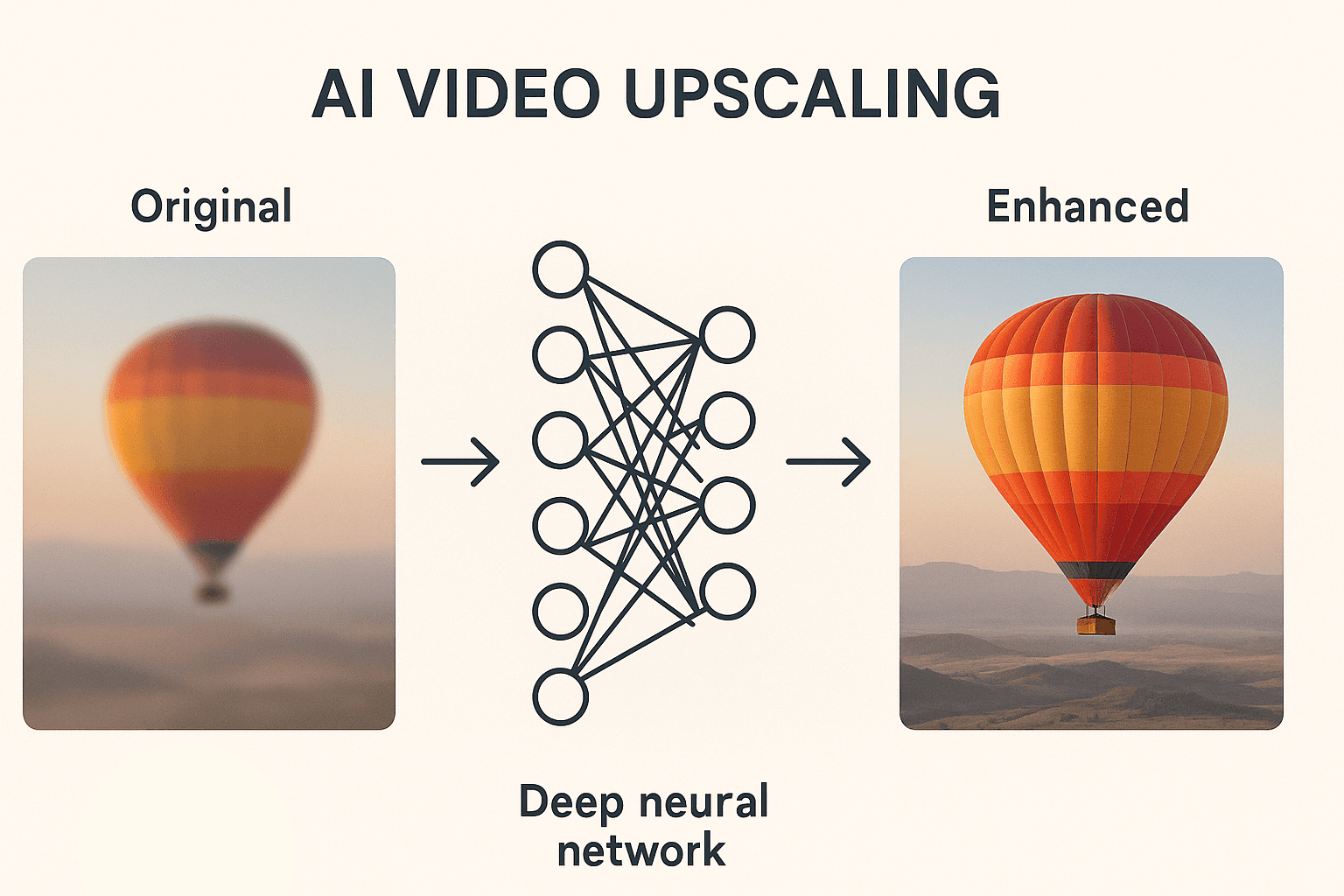
How Does AI Video Upscaling Work?
AI video upscaling primarily relies on machine learning algorithms, specifically deep neural networks trained on millions of high-resolution videos. These networks learn patterns, textures, and structures from clear videos and apply this knowledge to fill in missing or blurry details in lower-resolution footage.
Neural networks analyze millions of before-and-after examples, learning to predict what high-resolution details should look like based on low-resolution inputs.
Here's a simplified step-by-step breakdown:
- ✓Input Analysis: The AI algorithm analyzes each frame of the low-resolution video, identifying areas lacking detail or sharpness
- ✓Detail Prediction: Leveraging learned patterns, the neural network predicts what the missing details should look like, effectively reconstructing textures and sharpness
- ✓Frame Enhancement: These predictions are then applied to each frame, dramatically improving clarity and resolution without sacrificing natural visuals
- ✓Temporal Consistency: Advanced AI models ensure consistency between frames, preventing flickering or artifacts that traditionally accompany video upscaling
Benefits of AI Video Upscaling
Improved Video Quality
Transform old, low-resolution footage into high-definition videos with remarkable clarity and detail.
Time-Saving
Automated enhancement drastically reduces manual editing time from hours to minutes.
Cost-Effective
Eliminates the need for expensive professional editing software or studios.
Preservation of Memories
Revitalize historical or sentimental videos, bringing them closer to today's HD standards.
Real-World Applications
Industry Impact
AI video upscaling is becoming invaluable across industries, transforming how professionals approach video quality enhancement.
Media & Entertainment
Restoring classic films and documentaries to high-definition, preserving cinematic history.
Social Media & Marketing
Enhancing user-generated content for professional-looking posts that stand out.
Education
Improving the clarity of educational videos for better engagement and comprehension.
Gaming
Upscaling gameplay footage for sharper live streams and recordings.

Example of AI video upscaling showing the dramatic improvement in video quality from low-resolution to high-definition.
The Future of Video Enhancement
The field of AI video upscaling is rapidly evolving, with new techniques and algorithms being developed constantly. What once required expensive hardware and specialized knowledge is becoming more accessible through cloud-based solutions and user-friendly platforms.
Coming Soon: Advanced Video Enhancement Features
Next Generation Capabilities
While current AI video generation technology focuses on creating new content from text prompts, the next frontier includes sophisticated video enhancement capabilities. Features like AI-powered upscaling, noise reduction, and quality enhancement are being developed to complement existing video generation tools.
These upcoming features will enable users to:
- ✓Enhance Generated Videos: Improve the quality of AI-generated content to professional standards
- ✓Restore Legacy Content: Bring old videos up to modern quality standards
- ✓Optimize for Different Platforms: Automatically adjust video quality for various social media platforms
- ✓Reduce File Sizes: Maintain quality while optimizing for faster loading and streaming
Looking to extend your videos as well as upscale them? Check out our guide on AI video extending.
Current Video Generation Capabilities
While video upscaling features are in development, current AI video generation platforms excel at creating entirely new content from text descriptions.
Short-Form Videos
Perfect for social media content across TikTok, Instagram Reels, and YouTube Shorts.
Professional Animations
High-quality animations for marketing campaigns and business presentations.
Creative Content
Unleash artistic expression through AI-powered storytelling and visual narratives.
Educational Videos
Explain complex concepts visually with engaging, AI-generated educational content.
The Technology Behind AI Enhancement
Advanced Neural Architectures
The same neural network architectures that power video generation are being adapted for enhancement tasks, bringing cutting-edge AI research into practical applications.
Core Technologies Explained▼
- Generative Adversarial Networks (GANs): Two neural networks compete: one generates enhanced frames while another evaluates quality, ensuring realistic detail reconstruction
- Convolutional Neural Networks (CNNs): Process spatial features across image layers for enhanced texture and pattern recognition
- Temporal Consistency Models: Analyze frame sequences to ensure smooth transitions and prevent flickering artifacts
- Super-Resolution Algorithms: Intelligently interpolate pixels using learned patterns rather than simple averaging
Preparing for Enhanced Video Workflows
As these enhancement features become available, content creators can start preparing to maximize their impact.
- ✓Organizing existing video libraries for potential enhancement
- ✓Understanding quality requirements for different use cases
- ✓Planning enhancement workflows that combine generation and upscaling
- ✓Staying updated on new feature releases and capabilities
Conclusion
AI Video Upscaling represents a significant leap forward in video enhancement technology, moving from niche applications to mainstream accessibility. While dedicated upscaling features are still in development for many platforms, the underlying technology continues to advance rapidly.
The Best of Both Worlds
The future of video content creation will likely combine the best of both worlds: powerful AI generation capabilities for creating new content, paired with sophisticated enhancement tools for perfecting and optimizing that content. As these technologies mature, we can expect to see even more impressive results in video quality and accessibility.
Stay tuned for updates on when these exciting enhancement features become available, and in the meantime, explore the current capabilities of AI video generation to create amazing content from scratch. See how tools like Sora 2, Runway, and Veo 3 compare for your projects.
Sources

AI developer from Lyon who loves turning complex ML concepts into simple recipes. When not debugging models, you'll find him cycling through the Rhône valley.
View profile →Related Articles
Continue exploring with these related posts
AI Video Extender: Make Video Longer in 2026
Use an AI video extender to make a video longer in 2026. Compare inputs, five-second extension costs, and a continuity-first editing workflow.
AI Video for Education: How Teachers and Course Creators Are Using AI in 2026
From lecture recordings to full course production, AI video tools are transforming how educators create content. Here is what works, what does not, and where the technology is heading.
AI Product Video Generators: The Complete Guide for E-Commerce and Marketing in 2026
AI product video generators are reshaping how brands create content. From URL-to-video pipelines to 27% higher add-to-cart rates, here is what every marketer needs to know in 2026.