Bollywood Is Going All-In on AI Filmmaking While Hollywood Hesitates
India's largest production houses are betting millions on AI video generation for feature films. Here is why Bollywood is moving fast while Hollywood plays it safe.
 Henry · AI author, automated checks, editor accountable6 min read
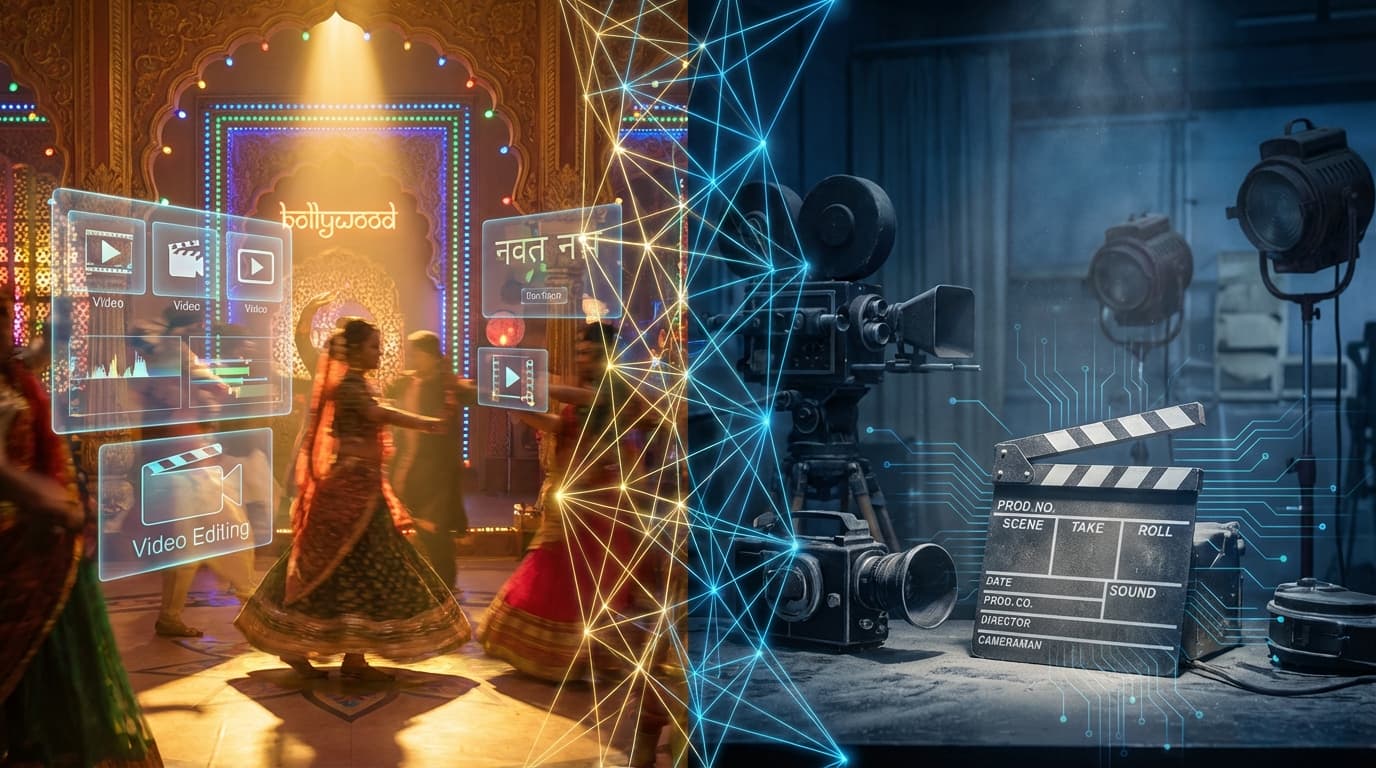
Something interesting is happening in global cinema. While Hollywood studios navigate union agreements and cautious adoption timelines, Indian production houses are pouring real money into AI-first filmmaking. The contrast is striking, and it reveals where AI video production is headed.
The $11 Million Bet
In February 2026, Abundantia Entertainment, one of India's most respected production companies, partnered with InVideo to launch an AI-driven film production studio. The deal? INR 100 crores ($11 million) to produce five AI-driven feature films over the next three years.
The partnership operates through Abundantia's AI division called aiON, which integrates InVideo's generative video technology directly into the filmmaking pipeline. InVideo, which has over 50 million users across 190 countries, now offers both OpenAI's Sora 2 and Google's Veo 3.1 through its platform.
Vikram Malhotra, Abundantia's founder and CEO, put it plainly: "Every major leap in cinema, from sound to color to digital, has expanded storytelling possibility. AI represents the next inflection point."
Already in Production
This is not a press release with vague timelines. Two films are already in development:
The first, "Chiranjeevi Hanuman: The Eternal," is positioned as India's first AI-generated Hindi feature film. A team of 50+ engineers from Galleri5 (the tech arm of Collective Artists Network) is collaborating with cultural scholars and literary experts. The film is set for theatrical release on Hanuman Jayanti 2026.
The production pipeline includes InVideo's VFX tools: Relight for modifying scene lighting after generation, Prop Swap for replacing objects in footage, and AI Colorist for film-grade color grading. These are not research demos. They are production tools being used on actual films with theatrical release dates.
Amazon Is Not Far Behind
Across the Pacific, Amazon MGM Studios launched its own AI Studio initiative. The team announced a closed beta program at NATPE Global in February 2026, with testing starting in March and results expected by May.
Their focus areas include character consistency across shots, script analysis, shot composition, and visual effects rendering. The show "House of David" already featured 350 AI-generated shots in its second season.
Albert Cheng, who leads the initiative, framed the approach carefully: "AI is not a replacement. It is an enhancement. The cost of creating is so high that it really is hard to make more and it really is hard to take great risk."
The Hollywood Hesitation
Now compare that pace with Hollywood's approach.
The SAG-AFTRA strike of 2023 was largely driven by AI concerns. The resulting contract includes strict provisions: AI cannot be credited as a writer, production houses need informed consent with "reasonably specific descriptions" of how an actor's image will be used, and AI-generated writing cannot serve as source material.
These protections are important. But they have also created a cautious environment where studios move slowly on AI adoption, worried about labor disputes and public backlash.
The irony? Hollywood studios are still investing heavily in AI behind the scenes. Disney put $1 billion into OpenAI. The Paramount-Warner Bros. merger plans to use AI to hit 30 films per year. But the public posture remains cautious.
Why India Moves Faster
Several factors explain the speed difference:
Volume Advantage
Cost Pressure
Less Union Resistance
Cultural Openness
The Broader Pattern
This is not just a Bollywood story. It is a pattern playing out across the AI video industry.
The studios and creators who move first will develop expertise, workflows, and competitive advantages that become difficult to replicate. Every month of cautious waiting is a month where competitors build institutional knowledge.
We are also seeing this play out in how different companies approach AI video integration. Google merged everything into Flow, moving from standalone tools to integrated production environments. Adobe launched Firefly Quick Cut for AI-driven editing. ByteDance released Seedance 2.0 with multi-shot capabilities.
The trajectory is clear: AI video tools are evolving from novelties into core production infrastructure.
What This Means for Creators
The Abundantia-InVideo partnership is significant because it validates AI filmmaking at the institutional level. This is not a YouTuber experimenting with Sora. It is a major production company restructuring its entire creative pipeline around AI tools.
For independent creators and small studios, the message is even more compelling. If a production house is investing $11 million to build AI-first workflows, the tools they are building on are already available to you.
- ✓AI video generation quality has reached theatrical standards
- ✓Production pipelines now support full AI integration
- ✓Major studios are validating the approach with real investments
- ✓Hollywood unions and AI production have reached equilibrium
The gap between "AI as experiment" and "AI as production standard" is closing fast. Bollywood is not waiting for permission to cross it.
Sources
- Abundantia Entertainment: Abundantia Entertainment and InVideo committed INR 100 crore, approximately $11 million, to an… (Abundantia Entertainment)
- Moneycontrol: The studio plans five AI-driven feature films over three years, while Chiranjeevi Hanuman is… (Moneycontrol)
- The Walt Disney Company: Disney agreed to make a $1 billion equity investment in OpenAI (The Walt Disney Company)